If you live in the San Francisco Bay Area and you are planning a bathroom remodel, the vanity you choose needs to do more than look good. It needs to survive. The Bay Area’s famously unpredictable microclimates, ranging from the perpetual fog of the Outer Sunset and Daly City to the dry inland heat of Livermore and Concord, create wildly different conditions inside homes, and your bathroom is where those conditions hit hardest.
The short answer: vanity styles built from moisture-resistant hardwoods like white oak and teak, marine-grade plywood, or PVC-wrapped cabinetry, paired with quartz or porcelain countertops, perform best across Bay Area climate zones. But the longer answer is far more useful, and that is what this article is about.
Why the Bay Area Climate Makes Vanity Selection Unusually Important
Most people treat vanity shopping as a purely aesthetic decision. Bay Area homeowners cannot afford to. The region’s microclimates are some of the most varied of any metro area in the United States, and they create indoor humidity conditions that differ dramatically from one zip code to the next.
What Each Climate Zone Does to Your Bathroom
Here is how the Bay Area’s geography plays out for indoor moisture conditions:
- Coastal and fog-belt zones (Outer Sunset, Richmond District, Pacifica, coastal Marin): Marine layer fog rolls in almost daily. Neighborhoods closer to the coast tend to be foggier and cooler. That persistent dampness infiltrates bathrooms, lingers in enclosed cabinetry, and over time causes particle board to swell, painted MDF to bubble, and lower-grade wood joints to fail.
- East Bay mid-zones (Oakland, Berkeley, Alameda, Emeryville): Oakland is sunnier than San Francisco, though areas near the bay remain cooler and foggier. Conditions vary block by block depending on elevation and proximity to the water.
- Inland East Bay and Central Valley edge (Pleasanton, Walnut Creek, Livermore, Concord): The opposite problem appears here. Blistering summer heat and very low humidity can cause certain wood vanities to dry out and crack if they are not finished correctly.
- South Bay (San Jose, Palo Alto, Mountain View, Los Gatos): A Mediterranean climate brings warm dry summers and mild wet winters, though the fog line near the Santa Cruz Mountains still introduces moisture in western pockets.
California’s building codes require bathroom exhaust fans to vent outdoors and typically mandate humidistat controls capable of operating within a relative humidity range of roughly 50 to 80 percent. That regulatory baseline tells you something important: even the state of California acknowledges that bathrooms here face a distinct moisture challenge.
The Materials That Actually Hold Up in Bay Area Bathrooms
Before getting into specific vanity styles, it is worth understanding which materials perform reliably in high-humidity coastal environments and which ones quietly deteriorate behind beautiful facades.
White Oak and Teak: The Hardwoods Worth the Investment
Solid hardwoods like white oak and teak are excellent for high-humidity areas when sealed correctly. Here is how each performs:
- White oak has become the material of choice for Bay Area custom vanity makers because its tight grain structure naturally resists moisture absorption better than softer woods like pine or alder. When finished with a low-VOC water-based polyurethane or hard wax oil, white oak performs beautifully even in fog-belt neighborhoods.
- Teak is the gold standard for coastal environments. Its high natural oil content makes it inherently water-resistant without requiring aggressive chemical sealants, which matters in California given CARB (California Air Resources Board) regulations around VOC emissions in interior finishes.
- Walnut is a strong performer in drier inland zones where its warmth and rich grain can be appreciated without the constant moisture stress that coastal environments impose.
Marine-Grade Plywood: The Smart Substrate
Marine-grade or boiling-waterproof plywood consists of panels bonded with waterproof phenolic resins that resist warping in steamy bathrooms. Key reasons Bay Area designers specify it:
- It does not absorb moisture the way standard construction-grade plywood does
- The phenolic resin bonding prevents delamination even in sustained humidity
- It serves as a reliable core substrate beneath wood veneers or painted finishes, where moisture damage typically starts first
- It is CARB-2 compliant when sourced from reputable domestic suppliers
PVC-Wrapped MDF: Budget-Smart and Genuinely Waterproof
PVC-wrapped vanities bond vinyl to MDF under heat, so steam cannot sneak between layers and swell the core. For homeowners in high-fog zones like the Outer Sunset or Daly City who are working within a tighter budget, PVC-wrapped cabinetry is a legitimate and durable option.
- 100% waterproof and will not warp or rot
- Significantly less expensive than solid hardwood
- Available in convincing wood-look laminates that suit modern and coastal aesthetics
- Best paired with a wall-hung installation to keep the base away from floor-level moisture
Materials to Avoid in Bay Area Bathrooms
Some materials look attractive in a showroom but underperform quickly in the Bay Area’s moisture conditions:
- Standard particle board: Absorbs moisture readily, swells at the joints, and can foster hidden mold growth inside cabinets
- Unsealed MDF: Highly vulnerable to swelling wherever water contacts unsealed edges or surfaces
- Uncoated softwoods like pine or poplar without proper primer and topcoat in fog-belt installations
- Low-grade chrome or zinc hardware: Corrodes visibly within a few years in humid coastal conditions
Vanity Styles That Balance Bay Area Aesthetics and Climate Resilience
The Floating Wall-Mounted Vanity
Best for: Fog-belt neighborhoods, small bathrooms, contemporary and Japandi interiors
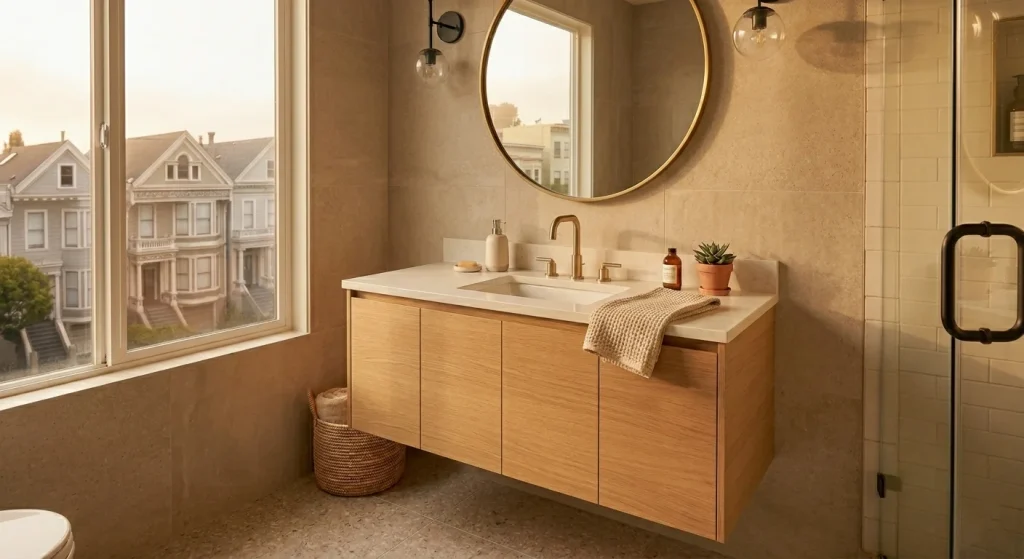
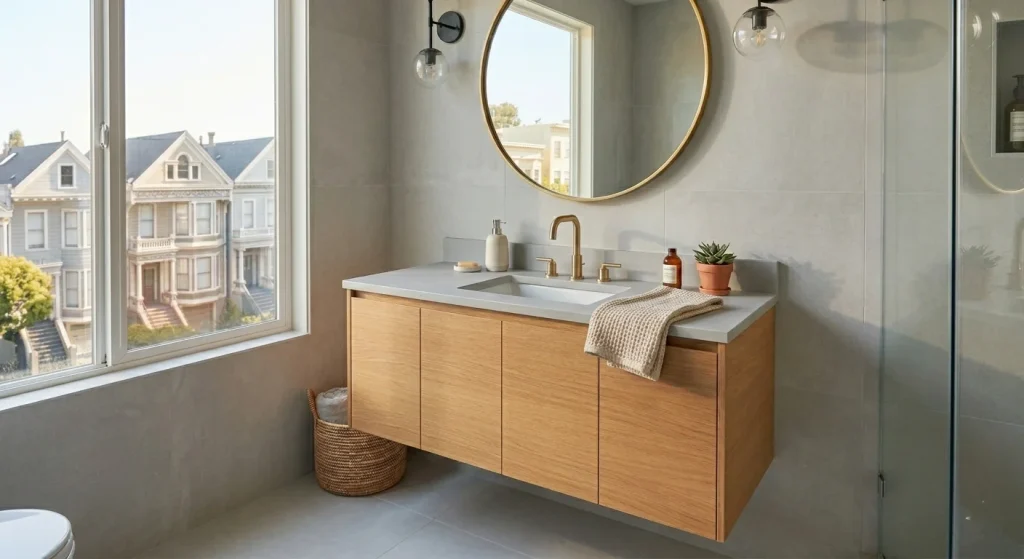
The wall-mounted or floating vanity has become the defining fixture of Bay Area modern bathroom design, and it earns that status on both aesthetic and practical grounds. Designers predict wall-hung units will be the biggest bathroom-furniture trend of 2026, thanks to the airy, bigger-than-it-is illusion they create.
Why it works so well in humid Bay Area conditions:
- Eliminates the enclosed floor-level base where moisture pools and accumulates
- The exposed floor beneath is easy to clean and dry, which is a significant hygiene advantage in humid environments
- No toe kicks or base panels sitting in contact with a wet tile floor, which is one of the most common failure points for freestanding vanities in coastal homes
- Air circulation beneath the cabinet prevents the trapped-moisture conditions that accelerate mold growth
What to specify for the Bay Area:
- Marine-grade plywood or solid hardwood carcass construction
- Stainless steel or rust-resistant alloy mounting hardware (low-grade brackets will corrode in fog-belt neighborhoods)
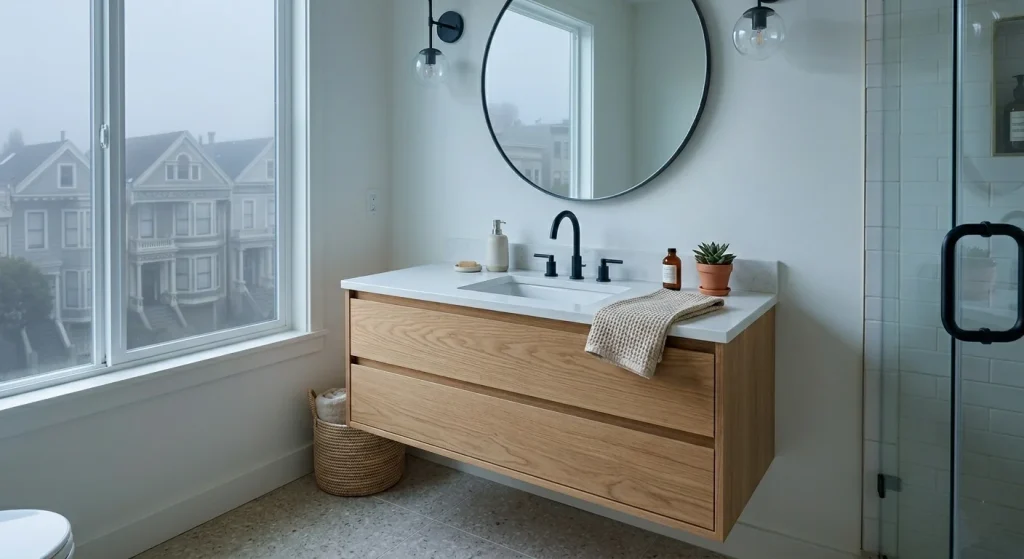
- White oak with a matte natural finish paired with quartz countertops
- Brushed brass or matte black hardware that adds warmth without competing with natural grain
The Shaker Style Vanity
Best for: Victorian, Craftsman, and Eichler homes across San Francisco, Oakland, and the South Bay
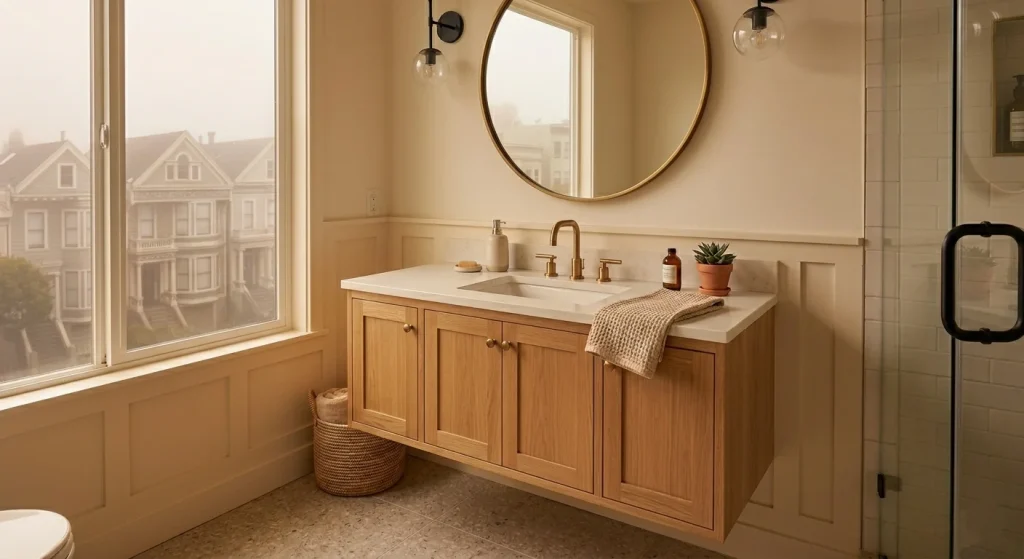
The Shaker vanity is arguably the most versatile style for Bay Area homes. Its clean recessed panel doors and unfussy hardware profile read comfortably in:
- Victorian Painted Ladies in the Mission and Pacific Heights
- Craftsman bungalows in Oakland, Berkeley, and Rockridge
- Mid-century modern Eichler neighborhoods in San Jose, Palo Alto, and Sunnyvale
- Contemporary new-build bathrooms where the style provides a grounding classic element
Climate considerations for Shaker vanities:
- In fog-belt neighborhoods, finish matters as much as style. Use a moisture-resistant primer and a hard-wearing topcoat on painted Shaker doors.
- A wood-toned Shaker vanity in white oak or maple with a sealed interior outperforms a painted version in high-humidity zones because the sealed cabinet interior prevents moisture buildup where towels and products are stored.
- Proper ventilation is crucial to maintain a Shaker vanity’s painted surface, as sustained humidity without exhaust ventilation will cause paint to bubble and peel at the edges of recessed panels.
The Organic Modern Vanity with Natural Wood Tones
Best for: Contemporary Bay Area homes seeking warmth, custom craftsmanship, and sustainability credentials
One of the strongest bathroom design trends emerging from Bay Area interior designers and local custom cabinet makers is the organic modern vanity. This style pairs:
- Warm natural wood tones (typically rift-cut white oak, walnut, or cerused oak)
- Minimal or invisible hardware
- Integrated or undermount sinks
- Quartz or honed marble countertops
- Matte black or brushed brass accents
This style is particularly well suited to the Bay Area because it aligns with the region’s broader design sensibility. Custom-built vanities are preferred over mass-produced imports here because they allow for better quality control and the use of eco-friendly, low-VOC finishes. A well-crafted wood vanity ages beautifully, developing a patina and character that synthetic materials simply cannot replicate.
Why rift-cut white oak is the standout material choice: Its straight, consistent grain pattern creates visual calm in the bathroom, and when finished with a matte hard-wax oil it develops warmth over time that gets more beautiful with each passing year.
The Japandi-Influenced Minimalist Vanity
Best for: South Bay tech-forward homes, small fog-belt bathrooms, new construction with contemporary detailing
Japandi design, a fusion of Japanese minimalism and Scandinavian functionality, has found a particularly receptive audience in the Bay Area. A Japandi vanity typically features:
- A low-profile silhouette with clean horizontal lines
- Natural wood in lighter tones such as ash, cerused oak, or light-stained maple
- Integrated or undermount sinks with no visible rim seam
- Almost no visible hardware, using push-to-open mechanisms or recessed finger pulls
- Quartz or large-format porcelain countertops
Climate advantage: The Japandi vanity’s preference for simple forms and sealed natural wood works in its favor in humid environments. There are no ornate carved details where moisture can accumulate, and the clean lines make maintenance straightforward. Paired with a wall-hung installation, a Japandi-style vanity is among the most climate-intelligent choices available.
The Coastal-Inspired Freestanding Vanity
Best for: Larger master bathrooms in Marin, the Peninsula, and East Bay homes with older wall construction
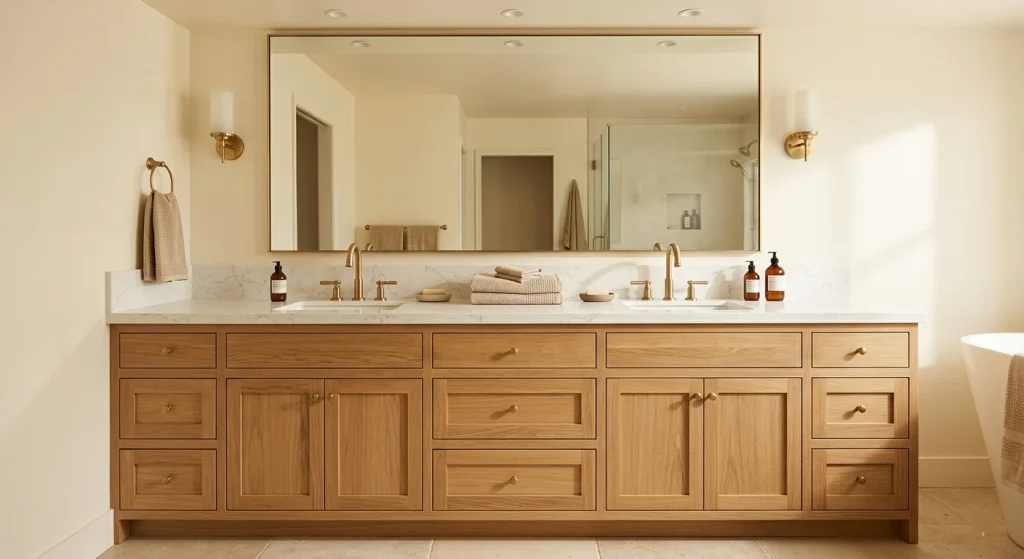
For larger master bathrooms where a grounded, furniture-like presence is preferred, a well-built freestanding vanity in solid hardwood remains a strong option. The key is specifying correctly.
What makes a freestanding vanity work in the Bay Area:
- Solid hardwood frames with dovetail drawer construction and low-VOC finishes
- FSC-certified woods and CARB-2-compliant panels for indoor air quality compliance
- Turned feet or legs rather than a full enclosed base, so air can circulate beneath the cabinet rather than trapping moisture against the floor
- Quartzite or quartz countertops rather than marble in higher-humidity zones
Installation advantage in older Bay Area homes: Freestanding vanities do not depend on wall stud placement or structural reinforcement, making them a more forgiving option in older Victorian and Edwardian-era homes where wall construction may not accommodate the blocking required for a floating installation.
Countertop Materials for Bay Area Vanities
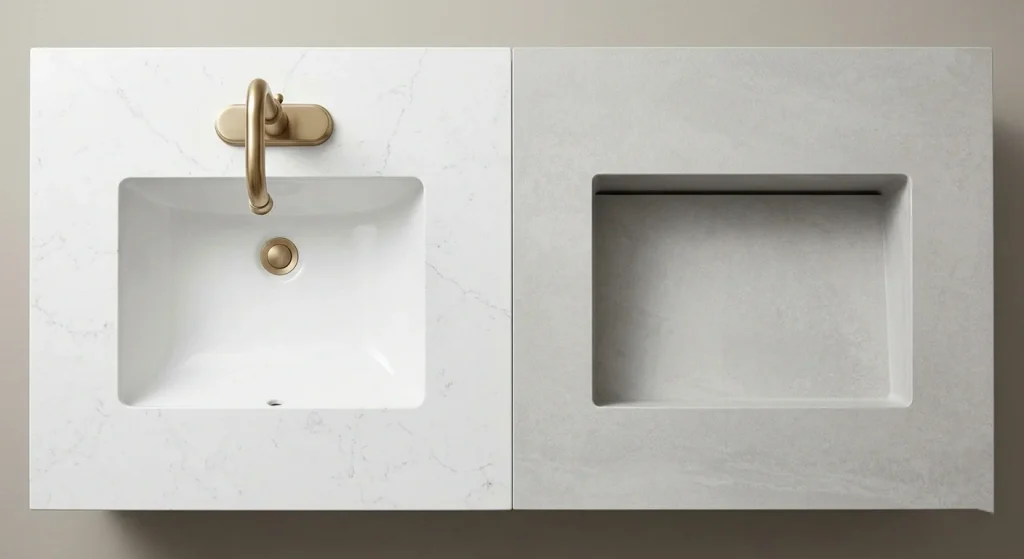
The countertop is the most moisture-exposed surface on any vanity, and the Bay Area’s climate conditions make material selection critical here too.
Quartz: The Workhorse Choice
Quartz engineered stone is the most consistently reliable countertop option across all Bay Area climate zones and all budget levels. Here is why:
- Near-zero water absorption requiring no sealing, ever
- Mohs hardness of 7, making it the most scratch-resistant standard option
- Lifespan of 25 or more years according to NKBA research
- Available in formats that closely mimic marble and natural stone without the maintenance demands
- Non-porous surface that resists mold and mildew colonization in fog-belt bathrooms
Porcelain Slab: The High-Performance Premium Option
Large-format porcelain slab countertops have emerged as a premium choice in Bay Area bathroom remodels for several compelling reasons:
- Completely impervious to moisture absorption
- Zero maintenance and no sealing required
- Available in formats that wrap the vanity top and backsplash in a single unbroken surface, eliminating all grout lines where mold establishes
- Heat-resistant and UV-stable, important for South Bay homes with significant sun exposure
- Extremely stable dimensionally, resistant to the thermal cycling that inland Bay Area homes experience
Honed Marble: Beautiful with Real Caveats
Honed Carrara marble suits the organic modern and Japandi aesthetics exceptionally well, and it appears frequently in Bay Area bathroom design for good reason. It does, however, require informed management:
- Requires annual sealing without exception
- Calcite in marble is vulnerable to etching from acidic bathroom products like toothpaste and some facial cleansers
- Performs reasonably well in well-ventilated inland microclimate bathrooms like Walnut Creek or Los Altos
- Not recommended for poorly ventilated fog-belt bathrooms where sustained humidity will stress an inadequately sealed surface
How Your Specific Bay Area Microclimate Should Influence Your Choice
Coastal and Fog-Belt Zones (Outer Sunset, Richmond, Pacifica, Coastal Marin, Daly City)
These neighborhoods face the highest sustained humidity in the region. The Pacific Ocean’s cold California Current creates persistent coastal fog as moist ocean air cools and condenses.
Recommended approach:
- Cabinet material: PVC-wrapped MDF (budget) or marine-grade plywood and teak (premium)
- Installation: Floating wall-hung to eliminate floor-level moisture accumulation
- Countertop: Quartz or large-format porcelain slab, no marble
- Hardware: Brushed stainless steel or matte black powder-coated
- Style: Japandi minimalist or organic modern with sealed natural wood tones
East Bay: Oakland, Berkeley, Alameda, and Emeryville
The East Bay presents a mixed picture depending on proximity to the water.
Recommended approach:
- Cabinet material: Sealed white oak or marine-grade plywood core cabinetry
- Installation: Floating preferred, freestanding acceptable for larger master bathrooms
- Countertop: Quartz is the safe choice; sealed marble works in well-ventilated Oakland Hills bathrooms
- Hardware: Matte black or brushed brass suits the Craftsman and mid-century architectural stock
- Style: Shaker or organic modern are the natural fits for East Bay home architecture
South Bay: San Jose, Palo Alto, Mountain View, Los Gatos
Santa Clara County’s Mediterranean climate is the most forgiving for wood vanities in the region, though winter rains and shower steam still make moisture-resistant materials a worthwhile investment.
Recommended approach:
- Cabinet material: Sealed white oak or walnut with penetrating oil finish
- Installation: Floating wall-hung dominates the South Bay’s contemporary aesthetic
- Countertop: Quartz or porcelain; properly sealed marble works in well-ventilated bathrooms
- Hardware: Matte black or brushed brass, both finishes hold well in this drier zone
- Style: Japandi minimalist and organic modern are particularly popular and well-suited here
Inland East Bay: Walnut Creek, Danville, Pleasanton, Livermore
These communities face the widest temperature swings in the region, with hot dry summers and cool sometimes-wet winters creating significant seasonal humidity variation.
Recommended approach:
- Cabinet material: Properly kiln-dried and acclimated solid white oak or teak
- Finish type: Penetrating oil finish rather than surface film finishes, which can peel when wood moves seasonally
- Installation: Either floating or freestanding works well here given lower baseline humidity
- Countertop: Quartz is the practical choice; sealed marble is workable in well-ventilated bathrooms
- Style: Shaker, organic modern, and transitional styles all suit the architectural mix of these communities
Ventilation, Hardware, and the Details That Make or Break Longevity
Choosing the right vanity style and material is necessary but not sufficient on its own. The surrounding conditions in your bathroom determine how long even a well-specified vanity will perform.
Exhaust Ventilation: Non-Negotiable in the Bay Area
A bathroom exhaust fan rated for your room’s cubic footage, ideally controlled by a humidistat rather than a manual switch, will extend the life of any vanity significantly by removing shower steam before it has time to settle into cabinetry and cabinet interiors. In fog-belt neighborhoods, this is not optional.
Hardware That Survives Coastal Conditions
Hardware finish selection matters more than most homeowners realize:
- Avoid: Standard chrome and zinc in fog-belt zones. Both will show corrosion within a few years.
- Choose instead: Brushed brass, matte black powder-coated, or solid stainless steel hardware in humid zones
- Check specifications: Mounting brackets and wall anchors for floating vanities must be stainless steel or rust-resistant alloy, as corrosion at the wall mount will gradually loosen the entire vanity
Sink Type and Installation Method
- Undermount sinks are preferable to drop-in sinks because they eliminate the rim seal between sink and countertop where water infiltrates over time and causes countertop substrate damage
- Integrated sinks, where basin and countertop are cast from the same material, eliminate this vulnerability entirely and are the premium choice for fog-belt bathrooms where sustained moisture is a persistent condition
Sustainability and Local Craftsmanship: A Bay Area Priority
One dimension of vanity selection that matters particularly to Bay Area homeowners is sustainability and local sourcing. Several points matter here:
- CARB compliance: CARB-compliant vanity cabinets meet stringent California Air Resources Board environmental standards for indoor air quality. This is especially important in smaller Bay Area bathrooms with limited ventilation.
- Local custom cabinet makers: Several custom cabinet operations across San Francisco, the East Bay, and the South Bay offer vanities built to order from sustainably sourced hardwoods with low-VOC finishes. Choosing locally made cabinetry gives you better quality control over materials, finish durability, and the ability to specify exact dimensions, wood species, and hardware suited to your microclimate.
- FSC-certified wood: Forest Stewardship Council certification ensures the hardwood in your vanity was sourced from responsibly managed forests, a standard that aligns with California’s broader environmental values.
- Longevity as sustainability: A well-crafted vanity that lasts 30 or more years is far more sustainable than replacing a poorly specified vanity every 8 to 10 years, which is a real outcome for homeowners who choose materials without considering Bay Area climate conditions.
Bringing It All Together: A Zone-by-Zone Quick Reference
| Bay Area Zone | Top Vanity Style | Best Cabinet Material | Countertop | Hardware |
| Outer Sunset / Richmond / Pacifica | Japandi floating or organic modern | Teak or PVC-wrapped MDF | Quartz or porcelain slab | Brushed stainless or matte black |
| Daly City / Coastal Marin | Floating modern or Shaker | Marine-grade plywood core | Quartz | Matte black powder-coated |
| Oakland / Berkeley / Alameda | Shaker or organic modern | Sealed white oak | Quartz or sealed marble | Matte black or brushed brass |
| Palo Alto / Los Gatos / Mountain View | Japandi or organic modern | Sealed white oak or walnut | Quartz or porcelain | Matte black or brushed brass |
| Walnut Creek / Danville / Livermore | Shaker or transitional | Kiln-dried white oak with oil finish | Quartz | Brushed brass or matte black |
Wherever you are in the Bay Area, the calculus is the same: understand your microclimate, specify materials that respect it, and choose a style that you will still love in twenty years. In this region, the vanity that survives well is the one that was chosen thoughtfully at the start.