
A Sunnyvale bathroom remodel transforms outdated, cramped bathrooms into modern, functional spaces. In real local projects, homeowners typically start with aging 1950s to 1970s ranch-home bathrooms featuring cracked tile, galvanized plumbing, and poor lighting, and finish with spa-inspired wet rooms, double vanities, frameless glass enclosures, and heated flooring. The full process, from design and permits through demolition and final inspection, takes 8 to 14 weeks and costs between $25,000 and $75,000 for most mid-range to high-end scopes in 2026.
What a Sunnyvale Bathroom Looked Like Before the Remodel
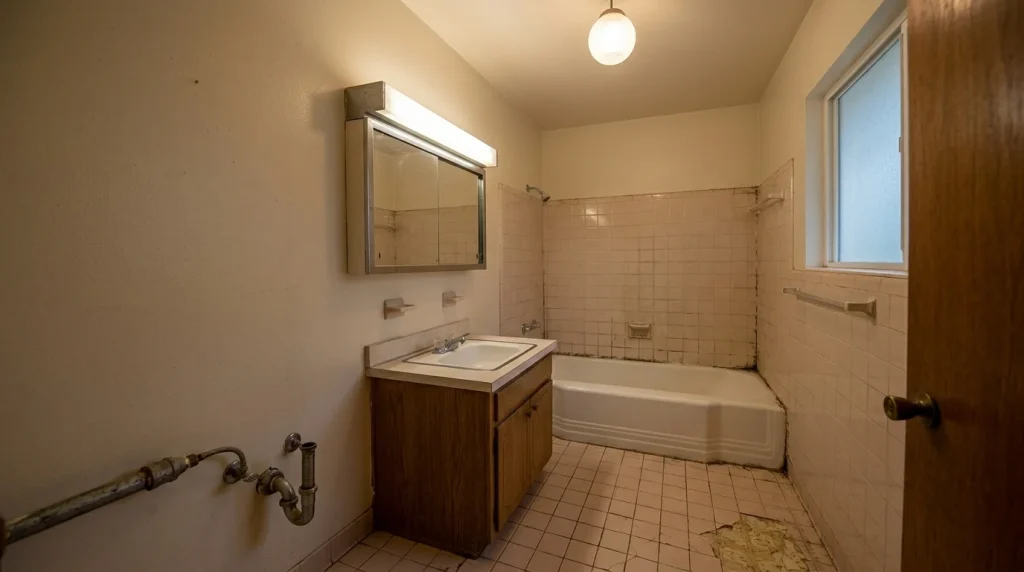
Most homeowners in Sunnyvale who pursue a full bathroom renovation are working with decades-old original construction. The neighborhoods of Birdland, Cherry Chase, Lakewood Village, and the blocks surrounding Downtown Sunnyvale are filled with ranch and tract homes built between 1950 and 1975. These bathrooms share a distinctive “before” profile that anyone who has toured one will immediately recognize.
The Flooring and Tile Conditions
The floors in pre-renovation Sunnyvale bathrooms are typically 4×4 inch ceramic tile laid directly over a mortar bed, with grout darkened by decades of use. Common flooring problems in these homes include:
- Cracked and lifted tiles from subfloor movement over decades
- Grout lines darkened with permanent staining and mold growth
- Tile-over-drywall wet areas in tub and shower surrounds that have absorbed years of moisture
- Linoleum or sheet vinyl layered over original subfloor in lower-end builder finishes
- Substrate damage hidden beneath the surface that only demolition reveals
Once that original tile is removed, the drywall substrate frequently comes apart with it. What looks like a cosmetic problem at the surface is often a structural one underneath.
The Plumbing Reality in Older Sunnyvale Homes
Mid-century California construction relied on materials that have long since reached the end of their useful life. The plumbing picture in a pre-remodel Sunnyvale bathroom typically looks like this:
- Cast-iron drain pipes that are intact but require new fittings to connect to modern drain configurations
- Galvanized steel supply lines corroded to the point where water pressure has degraded noticeably
- Single-handle fixtures with outdated valve systems that cannot be rebuilt with modern parts
- Pedestal sinks with no storage or counter space
- Toilets that predate modern low-flow standards, consuming 3.5 to 5 gallons per flush
Lighting, Ventilation, and Storage Shortfalls
Three areas where original Sunnyvale bathrooms consistently fall short are lighting, ventilation, and storage. Specifically:
- A single overhead ceiling fixture with a builder-grade globe shade provides inadequate task lighting
- Ventilation fans, where they exist at all, are undersized and too loud to run comfortably
- Original vanities ranged from 24 to 36 inches wide with no integrated medicine storage
- No counter space for two users sharing a primary bathroom
- Zero drawer or cabinet storage beneath the vanity in many pedestal-sink configurations
For families sharing a primary bathroom, these shortfalls create daily friction that a well-designed remodel can completely eliminate.
The Real Project: A Sunnyvale Primary Bath Transformation
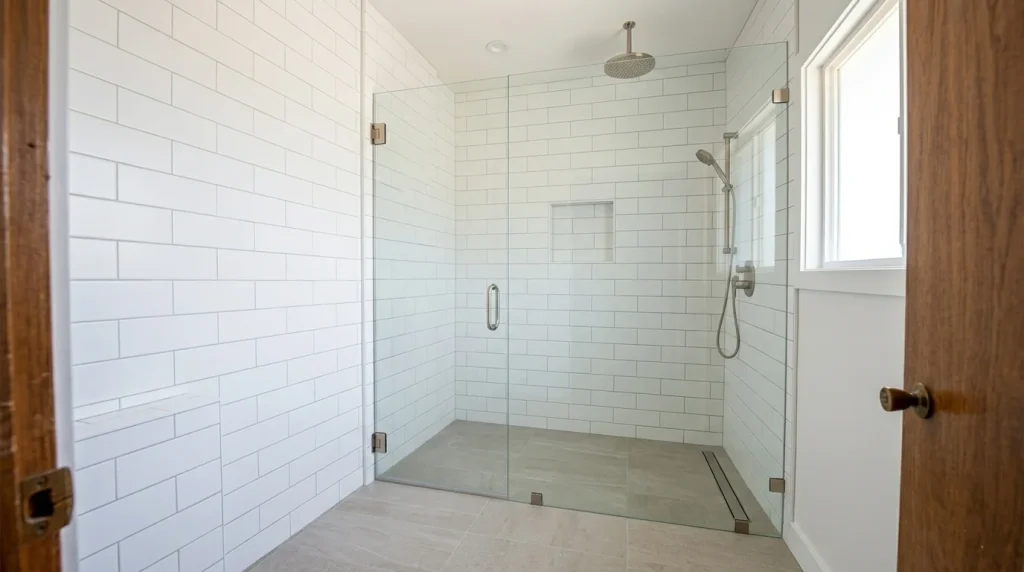
One representative project in Sunnyvale involved a 58-square-foot primary bathroom in a 1962 ranch home near El Camino Real. The homeowner had lived with the original layout for eleven years before committing to a full renovation. Here is how that project unfolded from concept to completion.
What the Homeowner Started With
The existing bathroom had the following conditions at the start of the project:
- A 5-foot alcove tub with a three-wall ceramic tile surround
- A 30-inch single-sink vanity with a builder-grade laminate countertop
- A surface-mounted medicine cabinet with a fluorescent strip light
- A single overhead ceiling fixture as the only light source
- Linoleum flooring installed over the original subfloor
- Galvanized supply lines with visibly degraded water pressure
- Original cast-iron drain pipes requiring ABS transition fittings
- Moisture damage and mold behind two of the three tub surround walls
Design Goals and Material Selections
The homeowner worked with a local Sunnyvale remodeling firm to develop a full 3D design before any demolition began. The primary goals for the project were:
- Replace the alcove tub with a curbless walk-in shower
- Widen the vanity from 30 inches to 60 inches with a double-sink configuration
- Add proper layered task lighting throughout the space
- Install a humidity-sensing exhaust fan to replace the undersized original
- Bring all flooring up to modern large-format porcelain tile standards
Material selections for the finished project included:
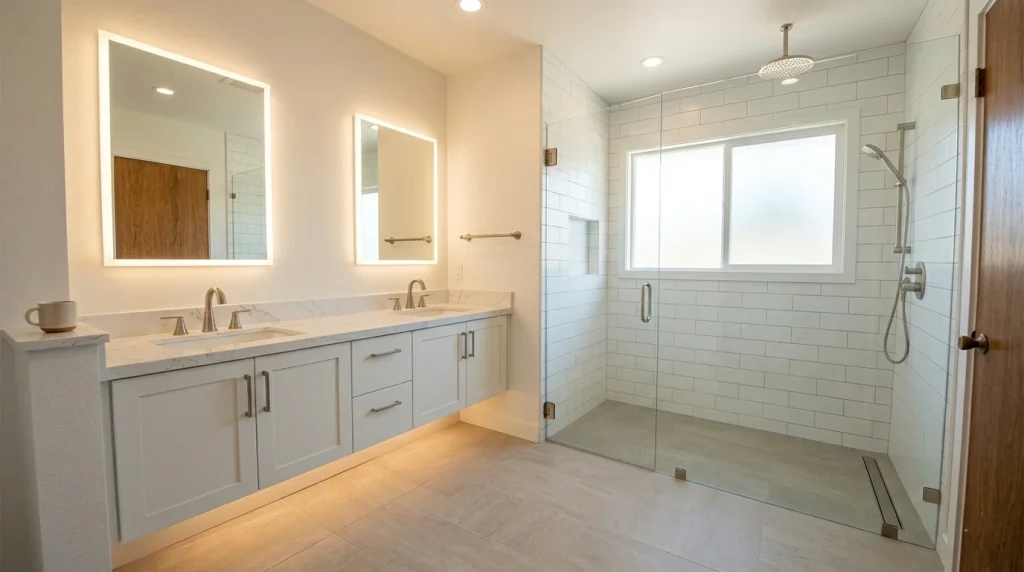
- Floor tile: 12×24 porcelain in a warm greige tone, brick-offset pattern
- Shower walls: 3×12 matte white subway tile in a running bond layout
- Countertop: Carrara marble-look quartz slab with undermount sinks
- Shower enclosure: Frameless glass, two fixed panels and one hinged door
- Hardware and fixtures: Brushed nickel finish throughout, including rain head and handheld wand
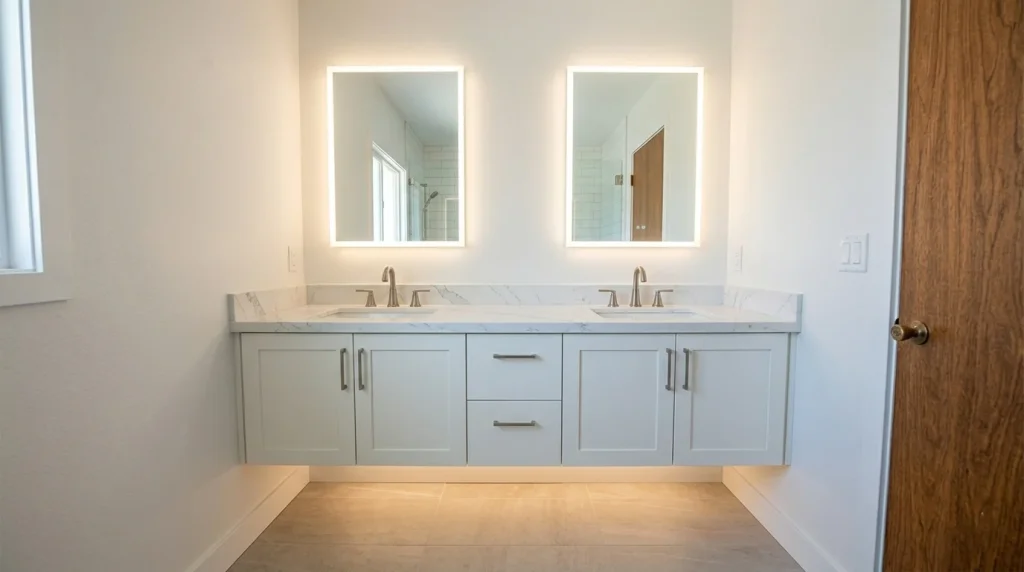
- Vanity: 60-inch floating cabinet with soft-close hardware and toe-kick lighting
- Mirrors: LED mirror panels recessed into the wall replacing the surface-mounted cabinet
The Permit Process in Sunnyvale
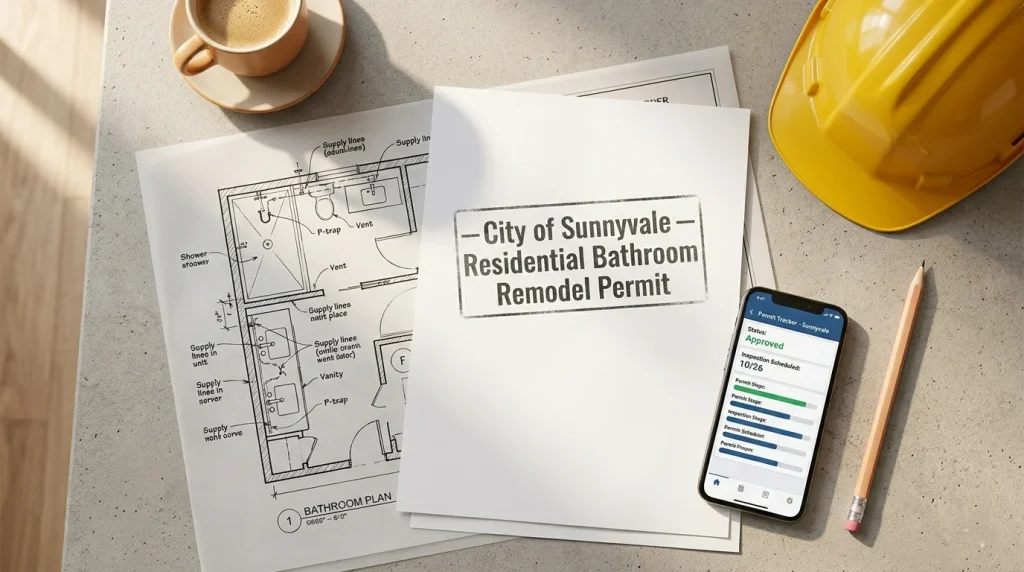
Because this project involved replacing the tub and shower, widening the vanity footprint, relocating electrical outlets, and installing a new exhaust fan, it triggered a full building permit under Sunnyvale’s municipal code. A full bathroom remodel permit is required any time two or more plumbing fixtures or trades are being updated simultaneously.
Here is how the permit process unfolded for this specific project:
- Permit type: Full building permit plus separate electrical and plumbing sub-permits
- Submitted to: One-Stop Permit Center at City Hall, 456 W. Olive Avenue
- Plan review duration: Four weeks, which is standard for peak spring and summer seasons
- Rough inspections required: PEX supply lines, updated drain configuration, electrical rough-in for lighting circuit and GFCI outlets
- Final inspection: Completed after tile, fixtures, and finishes were fully installed
- Total permit fees: $840 for this scope of work
Working without permits in Sunnyvale creates serious problems at resale and can trigger costly corrections when discovered during a home inspection. Every trade involved in this project was permitted and inspected.
Demolition: What They Found Behind the Walls
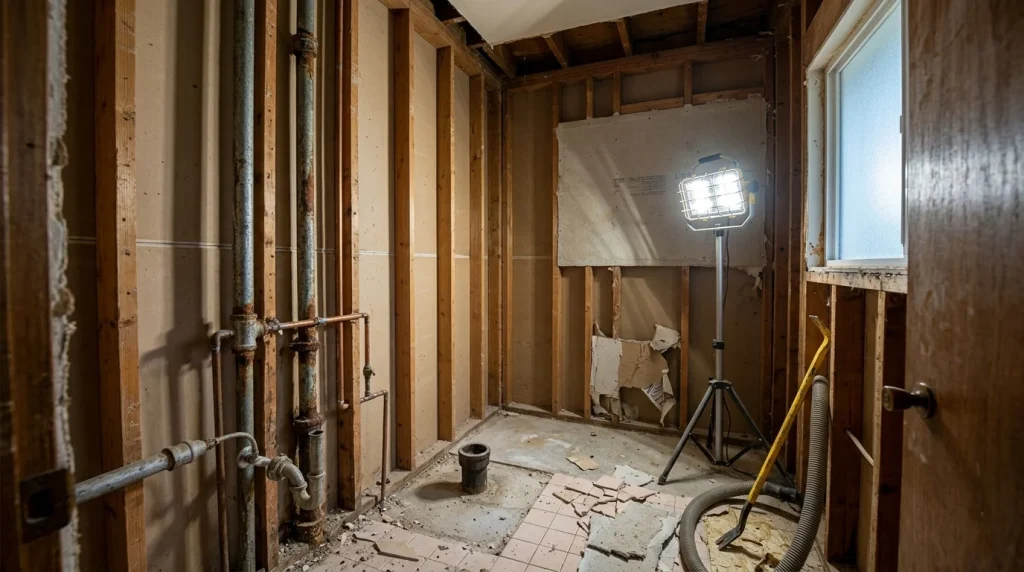
Demolition day on this project revealed exactly what experienced Sunnyvale contractors expect in homes of this vintage. The specific discoveries included:
- Galvanized supply lines severely restricted with mineral buildup, replaced entirely with PEX
- Two sheets of drywall behind the tub surround fully saturated with moisture, requiring complete removal
- Mold present behind the exterior-facing wall section of the tub surround
- Cement board and liquid waterproofing membrane required for full wet-area substrate replacement
- Minor wood rot in the floor framing near the exterior wall, requiring sistering of one joist section
- Cast-iron drain intact but needing new ABS transition fittings for the new shower drain configuration
The subfloor beneath the linoleum was solid, which kept the timeline on track. The joist sistering repair added approximately one day and $600 to the total project cost.
Construction and Installation: Phase by Phase
With rough inspections passed and the substrate properly prepared, the installation phase moved in a logical sequence:
Waterproofing and substrate:
- Cement board installed in all wet areas
- Liquid waterproofing membrane applied at shower floor, curb area, and lower wall sections
- Shower niche framed and waterproofed before any tile went up
Tile installation:
- Large-format floor tile set in a brick-offset pattern with a linear drain at the shower entry
- Shower walls tiled floor to ceiling in the subway tile running bond
- A single 6×6 decorative niche cut into the far shower wall for storage
- Continuous tile run from the vanity area into the shower to reinforce the sense of open space
Vanity and countertop:
- 60-inch floating vanity set and leveled with all soft-close hardware installed
- Undermount sinks set before countertop arrival
- Quartz countertop templated off-site, fabricated, and installed in a single day
- Toe-kick LED strip lighting installed to run the full vanity length
Fixtures and lighting:
- LED mirror panels recessed into the wall with concealed medicine cabinet storage behind each
- Recessed ceiling lights installed on a dimmer circuit
- Rain head and handheld wand shower system connected to new thermostatic valve
- 110-CFM humidity-sensing exhaust fan wired to run automatically based on moisture levels
- Frameless glass enclosure installed as the final installation step
The After: What Changed
The finished bathroom delivers a fundamentally different experience within the same 58 square feet. The specific improvements the homeowner noted after completion:
- The curbless shower reads as significantly larger than the alcove tub it replaced, with frameless glass keeping sight lines open across the full room
- Large-format tile running continuously from the vanity to the shower eliminates the visual choppiness of small-tile and grout-heavy original flooring
- Double sinks eliminated the daily morning congestion that had been a persistent frustration
- The floating vanity created open floor space that makes the room feel larger than its square footage
- Storage capacity increased dramatically from near zero to full-depth drawers and two recessed medicine cabinets
- Layered lighting from the LED mirrors, recessed ceiling fixtures on a dimmer, and toe-kick accent strip replaced a single harsh overhead light and transformed the character of the space entirely
What This Project Cost in Real Numbers
This Sunnyvale primary bathroom remodel came in at $51,400 total, including design fees, permits, all labor, and all materials. The cost broke down across major categories as follows:
| Cost Category | Amount |
| Demolition and disposal | $2,800 |
| Plumbing (PEX lines, shower valve, linear drain, vanity connections) | $9,200 |
| Electrical (lighting circuit, GFCI outlets, exhaust fan, dimmers) | $3,100 |
| Tile labor and materials (floor, shower walls, niche, linear drain trim) | $11,600 |
| Frameless glass shower enclosure | $4,200 |
| Vanity, quartz countertop, undermount sinks, hardware | $7,800 |
| LED mirror panels (pair) | $1,400 |
| Permits (building, electrical, plumbing) | $840 |
| General contractor fee (17% of direct costs) | $10,460 |
| Total | $51,400 |
For context, the same scope of work in a comparable California city outside the Bay Area would likely run 30 to 40 percent less. Sunnyvale’s construction market is shaped by the same forces that drive up every other cost in Silicon Valley: high demand from tech-sector homeowners, limited contractor availability, and labor rates that are among the highest in the state.
How Sunnyvale’s Local Conditions Shape Every Bathroom Remodel
Understanding Sunnyvale as a specific construction market, rather than treating it like any generic California city, is the difference between a project that stays on schedule and one that blows past budget.
Older Housing Stock and Hidden Conditions
The majority of Sunnyvale’s residential neighborhoods were built before 1975. Common baseline conditions in these homes that affect bathroom remodel budgets and timelines include:
- Cast-iron drain pipes requiring ABS transition fittings for connection to modern drain configurations
- Galvanized supply lines that need replacement with copper or PEX, adding $800 to $2,500 to project costs
- Tile-over-drywall wet areas where the substrate must be fully rebuilt with cement board and waterproofing
- Subfloor conditions not designed to handle the weight and installation requirements of large-format porcelain
- Wood rot in floor framing near exterior walls from decades of minor moisture intrusion
A contractor who has worked extensively in Sunnyvale will build contingency for these discoveries into the initial estimate rather than presenting a low bid and generating change orders after demolition.
Silicon Valley Labor Market Dynamics
Sunnyvale competes for skilled tradespeople in one of the tightest construction labor markets in North America. Current 2026 hourly rates in Sunnyvale are:
- Licensed plumbers: $125 to $200 per hour
- Electricians: $100 to $150 per hour
- Tile installers: $65 to $100 per hour
- General contractors: $75 to $150 per hour, or 15 to 20 percent of total project cost
These rates are consistently 25 to 40 percent above the broader California average. Reputable remodeling firms in Sunnyvale often carry minimum project thresholds of $20,000 to $25,000 for full bathroom work, and lead times of four to twelve weeks just to get on a contractor’s schedule are common during spring and summer.
Seismic Considerations and Updated Code Requirements
Under updated 2025 California Building Code requirements, homes with raised foundations that are more than 50 years old may require a seismic assessment as part of the permitting process. If that assessment triggers cripple wall reinforcement, the additional cost ranges from $1,500 to $5,000. Given that a significant share of Sunnyvale’s housing stock falls into this category, raising the question with your contractor during the bidding phase avoids a mid-project surprise.
Design Directions That Work Well in Sunnyvale Bathrooms
The compact footprints of Sunnyvale’s ranch-era bathrooms, typically 40 to 60 square feet for a full bath, reward specific design approaches that maximize the sense of space and light.
Space-Expanding Design Strategies
- Large-format tile (12×24 or larger) reduces the number of grout lines that visually segment the floor, making the room read as bigger
- Frameless glass shower enclosures keep sight lines open across the full room rather than visually dividing the space
- Floating vanities create open floor space below the cabinet that a floor-mounted unit cannot
- Continuous tile running from the vanity area into the shower reinforces the sense of a unified, open floor plane
- Recessed medicine cabinets add storage without projecting from the wall and shrinking the visual footprint
The Dominant Aesthetic: Spa-Inspired Design
Spa-inspired design is the most requested aesthetic among Sunnyvale homeowners undertaking primary bathroom renovations in 2026. The defining elements include:
- Natural stone or stone-look porcelain tile in warm neutrals
- Matte and honed surface finishes rather than high-gloss
- Warm neutral palettes in greige, warm white, and soft charcoal
- Freestanding soaking tubs where the floor plan permits
- Curbless wet-room style showers with rain heads and handheld wands
- Brushed or matte metal hardware finishes in nickel, bronze, or black
Aging-in-Place Features That Double as Design Choices
Homeowners in their 40s and 50s are increasingly incorporating accessibility features into remodels without making the space feel clinical. The most popular choices include:
- Curbless showers that eliminate a tripping hazard while reading as a luxury design feature
- Grab bars in finishes that match the rest of the hardware
- Comfort-height vanities at 36 inches rather than the standard 32 inches
- Wider doorways that improve usability without altering the visual character of the room
- Non-slip porcelain tile in the shower floor area with a honed rather than polished finish
Smart Bathroom Technology Now Entering the Mid-Range
What was a premium novelty two years ago is moving into standard expectation for mid-range Sunnyvale remodels in 2026:
- Humidity-sensing exhaust fans that run automatically without a wall switch
- Programmable thermostatic shower systems with digital temperature presets
- Heated floor systems with programmable thermostat controls
- LED mirrors with integrated lighting adjustment and anti-fog heating elements
- USB and wireless charging integrated into vanity drawers
How Long a Sunnyvale Bathroom Remodel Actually Takes
One of the most consistent gaps between homeowner expectation and project reality in Sunnyvale involves timeline. Here is a realistic phase-by-phase schedule for a mid-range full bathroom remodel:
| Phase | Typical Duration |
| Design and contractor selection | 2 to 4 weeks |
| Material ordering (specialty items, custom vanities, glass) | 4 to 8 weeks (run concurrently with permits) |
| Permit submission and approval | 3 to 6 weeks |
| Demolition | 1 to 2 days |
| Rough plumbing, electrical, substrate prep | 1 to 2 weeks |
| Rough inspections | 3 to 5 business days scheduling lag |
| Tile installation | 1 to 2 weeks |
| Fixture, vanity, glass, and finish installation | 1 to 2 weeks |
| Punch list and final city inspection | 3 to 5 business days |
| Total end to end | 8 to 14 weeks |
Luxury primary suite projects involving layout changes, custom fabrication, or structural work can extend to 16 to 20 weeks. The most important takeaway is that material lead times and permit approval run concurrently with each other, but both must be complete before demolition begins, meaning the planning phase is not dead time. It is active procurement time.
How to Choose the Right Contractor for a Sunnyvale Bathroom Remodel
The contractor selection process in Sunnyvale deserves as much attention as the design phase. The combination of high labor costs, city permit requirements, and older housing stock conditions means the difference between a contractor who knows this specific market and one who does not show up directly in budget and timeline outcomes.
What to Verify Before Signing Any Contract
Before committing to a Sunnyvale bathroom remodeling contractor, confirm the following:
- Current California CSLB (Contractors State License Board) license in good standing
- Active general liability insurance with a certificate naming you as additionally insured
- Workers’ compensation coverage for all employees and subcontractors
- Documented familiarity with Sunnyvale’s permit submission and inspection process
- Before and after photos from completed projects in Sunnyvale specifically, not just the broader Bay Area
- References from homeowners in pre-1975 Sunnyvale homes where hidden conditions were likely encountered
How to Evaluate and Compare Bids
Getting three competitive bids is standard advice, but evaluating them correctly is what matters. When reviewing bids for a Sunnyvale bathroom remodel:
- Compare them on scope alignment first, not price alone
- Look for a contingency allowance for substrate repair and plumbing discovery in older homes
- Ask how the contractor handles change orders when conditions behind the walls differ from assumptions
- Confirm that permit pulling and inspection coordination is included in the scope, not billed separately
- Be skeptical of bids significantly below competitors without a clear explanation of what is excluded
A contractor who builds contingency upfront and explains why is providing more honest and useful information than one whose low number disappears once demolition begins.
The Red Flags That Should End a Contractor Conversation
Remove any Sunnyvale contractor from consideration who does any of the following:
- Discourages pulling permits to save time or money
- Cannot provide a CSLB license number or proof of insurance immediately
- Requests more than 10 to 15 percent of the total as a down payment before work begins
- Has no direct experience with Sunnyvale’s permit center process
- Cannot show documented before and after photos from comparable local projects
What Sunnyvale Bathroom Remodels Do to Property Value
The Santa Clara County real estate market consistently rewards well-executed bathroom renovations at resale. Buyers in Sunnyvale’s price range, where median single-family home values sit well above the California average, expect updated primary bathrooms. A bath that still shows 1960s tile, original plumbing fixtures, and a single-sink vanity when comparable homes on the same street have been renovated is a measurable negotiating liability.
The Return on Investment for Sunnyvale Homeowners
Realtors active in the Sunnyvale and broader Silicon Valley market estimate returns on primary bathroom remodels as follows:
- 60 to 75 percent of the remodel cost typically returns in increased sale price
- The remainder is captured in faster time on market and reduced buyer concession requests
- A permitted, well-executed remodel reduces the inspection contingency risk that buyers use to negotiate price reductions
- An unpermitted or poorly executed remodel can actively complicate a sale rather than enhance it
Matching Remodel Scope to Your Timeline
The right remodel investment level depends on how soon you plan to sell:
If selling within 3 to 5 years: A mid-range remodel focused on clean, neutral, timeless design in quality materials will outperform a high-end renovation with very specific aesthetic choices that may not match future buyer preferences. Frameless glass, stone-look quartz, and brushed nickel have broad market appeal. Custom imported tile in a very specific colorway does not.
If staying long-term: The return on investment is personal as much as financial. A well-designed primary bathroom used daily for ten or fifteen years delivers value that does not show up in any appraisal but is felt every morning. In that context, prioritizing the finishes and features that actually match how you live in the space is the correct investment logic.
How to Start Planning Your Sunnyvale Bathroom Remodel
Almost universally, homeowners who have completed a Sunnyvale bathroom remodel say the same thing when asked what they would have done differently: they wish they had started the process earlier than they thought they needed to.
Why Starting Early Matters More Than Most Homeowners Expect
The timeline math in Sunnyvale does not compress the way homeowners hope. When you add up the real durations:
- Contractor lead times of 4 to 12 weeks just to get on a reputable firm’s schedule
- Permit review times of 3 to 6 weeks before work can legally begin
- Material procurement windows of 4 to 8 weeks for custom and specialty items
- Actual construction running 6 to 10 weeks for a full primary bath
The time between deciding to remodel and moving back into a finished bathroom is consistently longer than initial expectations. Decisions made slowly or changed mid-project multiply those delays.
The Planning Steps That Set Projects Up for Success
Homeowners who have the smoothest Sunnyvale bathroom remodel experiences consistently share these planning habits:
- Begin contractor outreach three to six months before the desired completion date
- Make all tile, fixture, and vanity decisions before demolition begins rather than during construction
- Order specialty and custom items as soon as the design is finalized, not after permits are approved
- Treat the planning phase with the same seriousness as the construction phase
- Budget a 10 to 15 percent contingency above the contractor’s base estimate for hidden conditions in older homes
Starting the design conversation with a qualified Sunnyvale contractor well before you feel pressured gives you the runway to make good decisions, wait for the right contractor rather than rushing into a commitment, and avoid shortcutting the permit process because a project has already started and time pressure has taken over.