
Converting a garage into an Accessory Dwelling Unit (ADU) in Sunnyvale is one of the most cost-effective ways to add legal, livable square footage to your property. The process involves:
- A structural assessment of the existing garage
- Architectural plan preparation meeting California’s Title 24 standards
- Submission to Sunnyvale’s Building Division for ministerial permit review
- Construction covering insulation, framing, electrical, plumbing, and a separate entrance
The city must respond to a complete application within 60 days under California state law, and garage conversions are exempt from replacement parking requirements across most of Sunnyvale.
If you own a single-family home in Sunnyvale and have been watching that dusty two-car garage sit largely unused while rental rates in Silicon Valley continue to climb, you are sitting on one of the most underutilized real estate opportunities in the Bay Area. A garage conversion ADU is not a shortcut or a loophole — it is a fully legitimate, city-approved path to creating a self-contained residential unit for a family member, a long-term tenant, or a multigenerational living arrangement. This guide walks you through every stage of the process, from understanding local regulations all the way through receiving your Certificate of Occupancy.
What a Garage Conversion ADU Actually Means in Sunnyvale
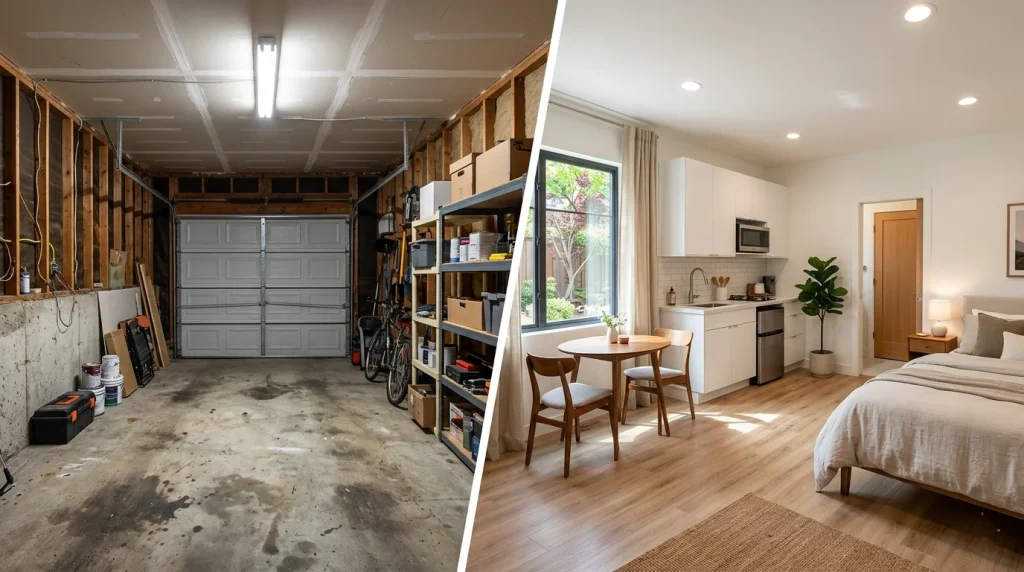
Before getting into permits and costs, it helps to understand exactly what California law and the City of Sunnyvale define as a garage conversion ADU. Under California’s Department of Housing and Community Development (HCD) guidelines, an Accessory Dwelling Unit is a residential unit offering complete, independent living facilities for one or more persons on the same lot as a primary residence. A conversion ADU specifically means taking an existing structure — in this case, your attached or detached garage — and transforming it into that self-contained unit.
How a Garage Conversion Differs From Other ADU Types
- Garage conversion ADU: Transforms an existing attached or detached garage into a fully independent residential unit with its own kitchen, bathroom, heating system, and separate exterior entrance
- New detached ADU: Built from scratch in the backyard, requiring new foundation, framing, and utility runs from the street
- Junior ADU (JADU): A smaller unit up to 500 square feet created within the walls of the existing primary home, not from a garage
Sunnyvale permits both attached garage conversions (where the garage shares a wall with the house) and detached garage conversions (a freestanding structure on the property). Both follow the same general permitting pathway, though the structural and utility connection considerations may differ slightly depending on layout.
Why Sunnyvale Homeowners Are Choosing Garage Conversions Over Other ADU Types
Sunnyvale is one of the most active cities in Silicon Valley for ADU construction, and it is easy to understand why. The city sits within commuting distance of major tech employers including LinkedIn and Juniper Networks, which keeps rental demand exceptionally high. The median rental value in Sunnyvale exceeds $3,800 per month, and the median property value is over $1.8 million, meaning any improvement that adds legal habitable space has a compounding effect on long-term equity.
Three Reasons Garage Conversions Lead the Pack
- No new foundation needed: The structure already exists, eliminating the cost and complexity of pouring concrete and erecting walls from scratch
- Faster permitting: No site grading, no foundation engineering, and no new utility trench means the city’s review process moves more quickly than new detached construction
- No yard space lost: Unlike a detached backyard ADU, a garage conversion keeps your outdoor space intact — a meaningful advantage on the compact single-family lots that define much of Sunnyvale’s residential neighborhoods
According to California’s Housing and Community Development data, ADU permit applications statewide increased by over 60 percent since 2020. Garage conversions represent a significant share of that growth, particularly in cities like Sunnyvale where existing housing stock consists largely of mid-century homes with attached or detached two-car garages that are structurally sound and easily adapted.
Sunnyvale’s ADU Regulations and How State Law Shapes Your Project
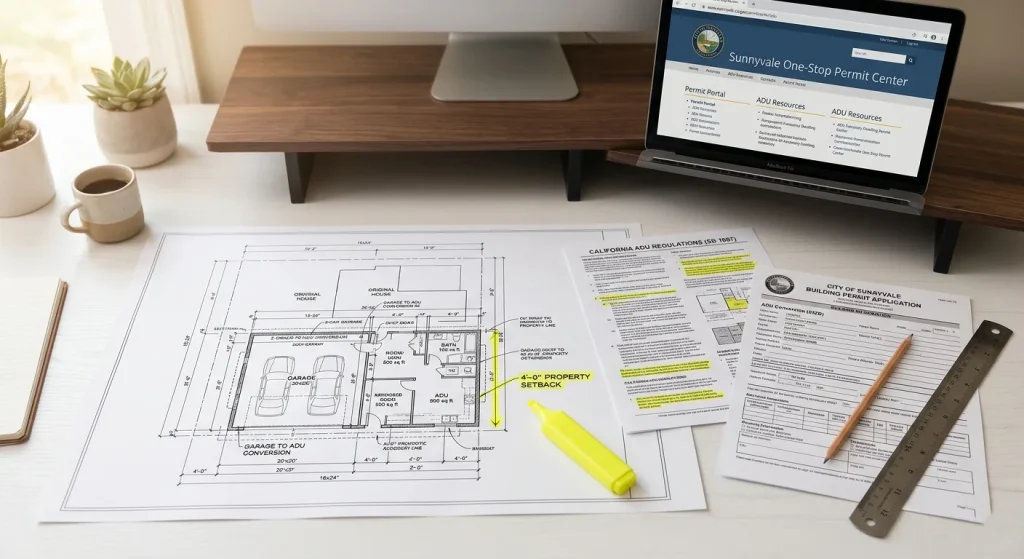
Sunnyvale applies local, objective standards that work alongside California’s statewide ADU framework. Understanding both layers helps you design a project that moves smoothly through plan check without revision cycles or unexpected conditions.
Size Limits That Apply to Your Garage Conversion
For a Standard ADU (SADU) created from an existing garage on a single-family or duplex property, Sunnyvale sets the following size limits:
- One-bedroom unit: Up to 850 square feet
- Two-bedroom or larger unit: Up to 1,000 square feet
- Attached ADU cap: Cannot exceed 50 percent of the existing primary dwelling’s square footage (e.g., a 1,400 sq ft house caps the attached conversion at 700 sq ft)
Most single-car and two-car garages fall comfortably within these limits, so the full footprint can typically be converted without shrinking the design.
Setback Rules for Converted Garages
One of the most important advantages of a garage conversion compared to new ADU construction is the setback exemption:
- Detached new construction ADUs require a minimum 4-foot setback from both rear and side property lines
- When converting an existing structure, the city cannot require it to meet the 4-foot setback if the garage already sits closer to the property line
- This means a detached garage built close to a rear fence — common on many Sunnyvale lots — does not need to be relocated or rebuilt to comply with current rules
Parking Requirements After Garage Conversion
Under current California law, Sunnyvale cannot require you to replace parking spaces lost when you convert a garage into an ADU. Key points:
- The exemption applies to properties within a half-mile of public transit, which covers the vast majority of Sunnyvale
- The city cannot mandate a new carport, driveway pad, or parking structure as a condition of approval
- This rule removes what was historically one of the most expensive barriers to garage conversion projects
Architectural Compatibility Standards
Sunnyvale’s local ordinance requires the exterior of your converted garage to:
- Match similar materials, colors, and appearance to the primary dwelling unit
- Feature a separate independent exterior access point
- Have an entrance that is not on the same wall plane facing the street as the primary home’s entrance
This is an objective standard, not a subjective design review, which means your contractor’s plans simply need to reflect consistent siding, roofing, and trim choices.
Short-Term Rental Restrictions
A permitted garage conversion ADU can be rented to long-term tenants, but there are clear boundaries:
- Short-term rentals of fewer than 31 days are prohibited — platforms like Airbnb and VRBO are not permitted for ADU rentals
- Newly created ADUs including conversions are exempt from state and local Rent Stabilization Ordinances for 15 years after the Certificate of Occupancy is issued
- This RSO exemption provides meaningful pricing flexibility during the early years of your rental operation
Step One: Evaluate Your Garage’s Eligibility and Structural Condition
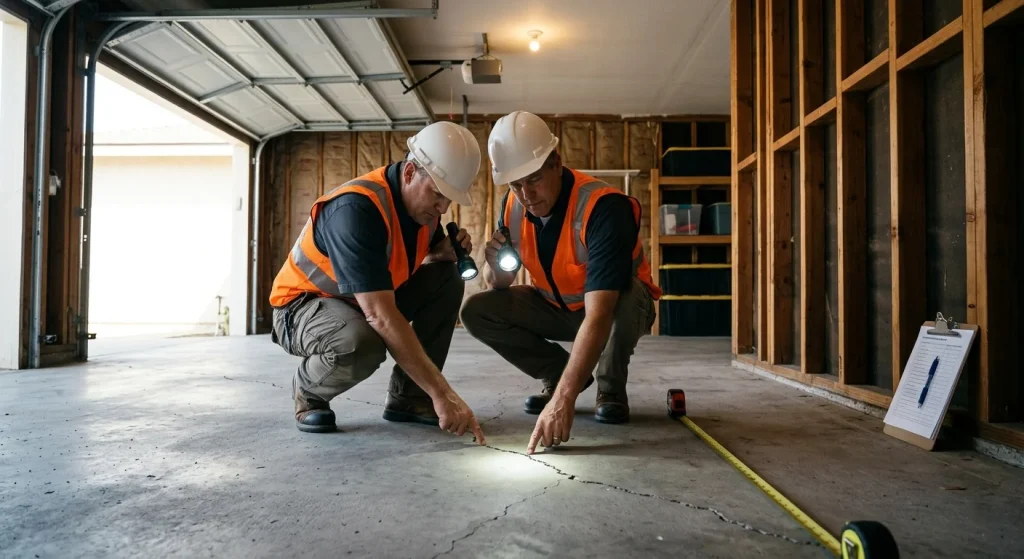
Every successful garage conversion begins with an honest structural assessment rather than a design wishlist. Before spending money on architectural drawings or permit applications, a licensed contractor or structural engineer should evaluate whether the existing garage can support the physical demands of a habitable residential unit.
Foundation Assessment
The foundation is the first concern. Many Sunnyvale garages built between the 1950s and 1980s were constructed on a slab without the reinforcement or depth required for a residential occupancy load. Watch for:
- Cracks, heaving, or soft spots in the existing slab — these may require a reinforced overlay or partial replacement
- Floor grade issues — a garage floor typically slopes toward a drain opening, and that slope must be leveled or built up to create a flat residential surface
- Drainage deficiencies that could lead to moisture intrusion once the space becomes habitable
Roof and Framing Evaluation
Your contractor will assess whether the existing wall framing can support added insulation, drywall, electrical runs, and plumbing. Common findings include:
- The need for supplemental framing or sistering of existing studs, particularly in older garages with two-by-four framing not designed to carry interior load
- Ceiling height shortfalls — habitable space typically requires a minimum of 7 to 8 feet, and low-pitched garage roofs often fall short without raising the plate height or reworking the ceiling framing
Zoning Eligibility Check
Before your first planning meeting, confirm the following with the City of Sunnyvale’s Community Development Department:
- Your property’s Assessor Parcel Number (APN)
- Your lot size and zoning classification
- Whether your parcel falls within a residential zoning district eligible for ADU development (all single-family and multifamily residential zones in Sunnyvale qualify)
Step Two: Assemble Your Design and Planning Team
Garage conversions in Sunnyvale require permitted architectural drawings that meet California’s Title 24 energy efficiency standards. Plans must be prepared by a licensed architect or certified building designer and must include:
- Structural details and calculations
- Energy compliance documentation
- Mechanical, electrical, and plumbing (MEP) schematics
- A dimensioned site plan showing the garage’s location on the parcel
What to Look for When Hiring a Design-Build Team
- Demonstrated experience specifically with garage conversion ADUs, not just detached new construction — the structural details, utility connection strategy, and energy compliance pathway differ meaningfully between the two
- Familiarity with Sunnyvale’s specific plan check comments and local inspector expectations
- Ability to determine early whether your project qualifies as a Junior ADU or a full Standard ADU based on your goals and the garage’s square footage
If the garage is attached and under 500 square feet, a JADU designation may be possible, though it comes with owner-occupancy requirements. If your goal is a fully independent rental unit with no owner-occupancy restriction, the Standard ADU pathway is the right choice.
Step Three: Navigate the Sunnyvale Permit Application Process
Sunnyvale processes ADU permit applications through its One-Stop Permit Center, and all submissions can be made online. The city operates under California’s ministerial review standard, which means:
- No public hearing is required
- No discretionary design review board weighs in
- No neighborhood notification process applies
- The planning staff uses objective standards only — the decision is administrative, not political
By state law, the city must approve or deny a complete application within 60 days.
What “Complete Application” Actually Means
The 60-day clock does not start until all required documents are on file. Incomplete applications are returned rather than reviewed. A complete package for a Sunnyvale garage conversion ADU typically includes:
- Dimensioned architectural floor plans and elevations
- Site plan showing the garage location, setbacks, and lot boundaries
- Structural calculations from a licensed engineer
- Title 24 energy compliance documentation
- Mechanical, electrical, and plumbing schematics
- Completed city application forms
Most applications in Sunnyvale move through review in 4 to 8 weeks when submitted with all required components.
Pre-Application Consultation With Planning Staff
Scheduling a pre-application meeting with Sunnyvale’s Planning Department before finalizing your permit package is strongly recommended. City staff can:
- Confirm which standards apply to your specific parcel
- Flag utility easements that might affect the project footprint
- Clarify whether your garage’s existing location requires any special approvals
- Identify any conditions tied to your zoning district
Permit Fees to Budget For
- Building permit fee — calculated based on project valuation
- Plan check fee
- Separate mechanical, electrical, and plumbing permit fees
- For ADUs under 750 square feet, state law has reduced or waived certain impact fees
- A Traffic Impact Fee (TIF) may apply for larger units depending on size thresholds
Step Four: Complete the Structural and Systems Work During Construction
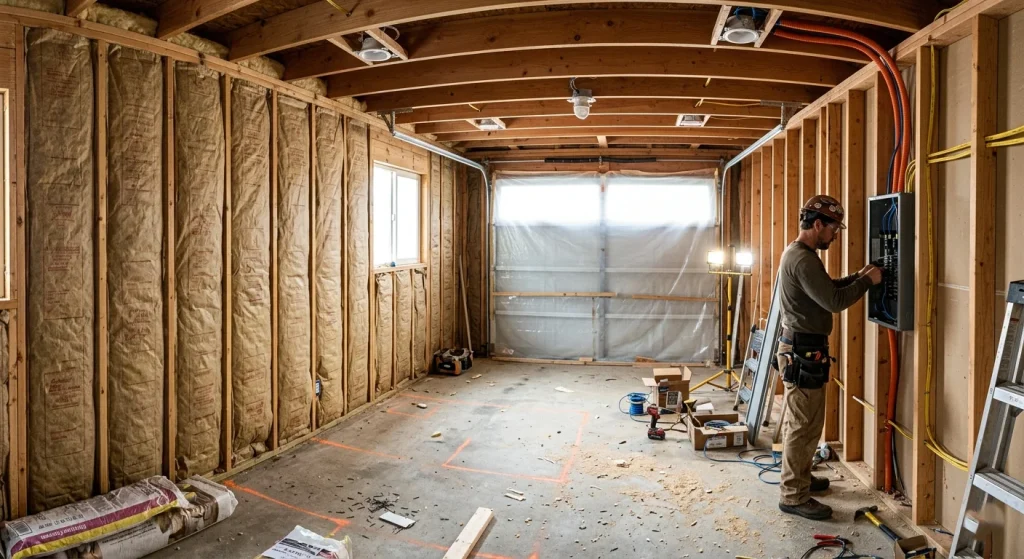
Once permits are issued, construction begins with demolition of the garage door and its framing, followed by sealing the opening with a framed wall, window, and the required exterior entrance. This is one of the most visually defining moments of the conversion — the moment the space stops looking like a garage and starts looking like a home.
Insulation and Energy Compliance
California’s Title 24 energy code applies to all newly habitable space, and garage conversions must meet the same insulation standards as new residential construction. Requirements include:
- Insulation of all exterior walls, the ceiling or roof assembly, and the floor above any unconditioned space to required R-values for Sunnyvale’s climate zone
- High-quality batt or spray foam insulation in wall cavities
- Rigid foam board on the interior face of concrete or masonry walls for block-construction garages
- Proper insulation is also the primary defense against Sunnyvale’s temperature swings — cold winter mornings and warm summer afternoons both put pressure on an under-insulated conversion
Electrical Upgrades
A garage that previously powered a door opener and a couple of outlets requires a complete electrical overhaul to serve as a residence. Code-compliant habitable space requires:
- Outlets at intervals of no more than 12 feet along each wall
- Dedicated circuits for kitchen appliances and bathroom equipment
- GFCI protection in all wet areas (kitchen, bathroom, laundry)
- Arc-fault circuit interrupters (AFCIs) in all habitable rooms under current California electrical code
- A new subpanel or main panel upgrade in most conversions to handle the additional electrical load from a full kitchen and bathroom
Plumbing for Kitchen and Bathroom
A full kitchen and bathroom is what elevates a garage conversion from a habitable room to a genuinely functional, high-rent rental unit. Plumbing requirements include:
- For attached garages: Lines connect to the main house’s existing system
- For detached garages: A new connection to municipal sewer and water supply may be required depending on distance and capacity
- Connection fees and capacity charges depend on the size of the unit and the number of plumbing fixtures proposed — research these early rather than treating them as an afterthought
Sunnyvale does not require separate utility connections for conversion ADUs as a general rule, though detached structures may need them depending on layout.
Heating Systems
Both attached and detached ADUs in Sunnyvale are required to have their own independent heating systems — a shared HVAC system serving both the primary home and the ADU is not permitted. The most common solution for Sunnyvale garage conversions:
- Mini-split heat pump systems — provide both heating and cooling in a single unit
- Require no ductwork, which simplifies installation in a converted space
- Operate quietly and meet California’s efficiency requirements
- Eliminate the need for gas line extensions in most cases
Step Five: Pass Inspections and Receive Your Certificate of Occupancy
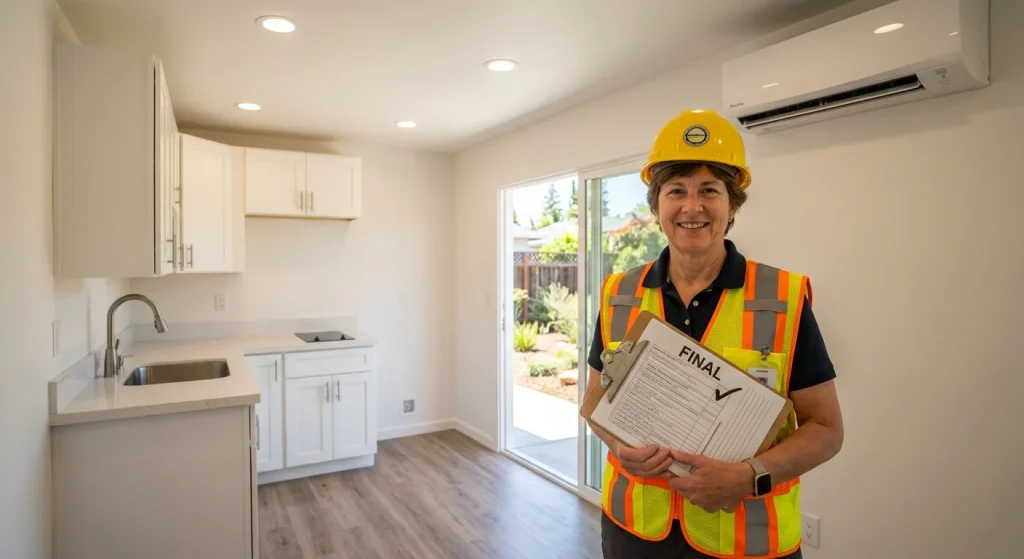
Construction does not end with the finished work — it ends with a series of inspections by Sunnyvale’s Building Division confirming every system was installed according to the approved plans and applicable codes.
Inspection Stages for a Garage Conversion ADU
- Foundation or slab inspection — confirms any remediation work was completed correctly
- Framing and structural inspection — verifies supplemental framing, sistering, and ceiling height compliance
- Rough plumbing inspection — conducted before walls are closed
- Rough electrical inspection — conducted before walls are closed
- Insulation inspection — conducted before drywall installation
- Final inspection — covers all completed systems and finishes
What the Final Inspection Covers
The final inspection is the most comprehensive. The inspector will verify:
- The separate entrance is properly installed and accessible
- Smoke detectors and carbon monoxide detectors are in place and functioning
- Kitchen and bathroom fixtures operate correctly
- The heating system functions as designed
- Exterior appearance matches the approved architectural plans
Once all inspections pass, Sunnyvale issues a Certificate of Occupancy for the ADU. This document is the legal authorization to occupy and rent the unit. Without it, allowing a tenant to live in the converted space creates significant liability, potential fines, and difficulties with financing or future property sales.
What a Garage Conversion ADU Costs in Sunnyvale
Construction pricing in Silicon Valley is among the highest in the country, and Sunnyvale garage conversion budgets reflect that reality.
Cost Ranges by Project Scope
| Scope | Estimated Cost |
| Basic conversion (insulation, electrical, simple bath, no kitchen) | $60,000 to $80,000 |
| Full conversion with kitchen, bathroom, laundry, HVAC | $100,000 to $175,000 |
| Complex conversion (deteriorated framing, asbestos remediation, detached plumbing) | $175,000 and above |
Older garages with deteriorated framing, inadequate foundations, or asbestos-containing materials in their original construction will trend toward the higher end of these ranges.
Rental Income and Payback Period
The investment consistently demonstrates strong returns in Sunnyvale’s rental market:
- A fully permitted one-bedroom garage conversion generates between $2,000 and $2,800 per month in long-term rental income
- Payback period typically falls in the range of 5 to 7 years before accounting for property value appreciation
- A conversion costing $130,000 that generates $2,400 per month produces roughly $288,000 in gross rental revenue over 10 years
The Distinction Between a Standard ADU and a Junior ADU for Garage Projects
Homeowners in Sunnyvale sometimes encounter the JADU option when researching garage conversions and wonder whether it applies to their project. Here is a clear side-by-side comparison:
Standard ADU vs. Junior ADU at a Glance
| Feature | Standard ADU (Garage Conversion) | Junior ADU (JADU) |
| Maximum size | 850 to 1,000 sq ft | 500 sq ft |
| Location | Attached or detached garage | Within existing primary home only |
| Kitchen requirement | Full independent kitchen required | Kitchenette allowed |
| Bathroom sharing | Own bathroom required | May share with primary home |
| Owner occupancy required | No (for Standard ADUs) | Yes |
| Rental flexibility | Long-term tenants, no occupancy restriction | Owner must live on-site |
A garage conversion that results in a fully independent unit with its own kitchen and bathroom is processed as a Standard ADU regardless of size. If your goal is an independent rental unit where you can offer the space to a tenant while maintaining flexibility to live elsewhere, the Standard ADU pathway is the correct one.
How the Conversion Affects Your Primary Home’s Expansion Rights
One aspect of garage conversion ADUs that Sunnyvale’s guidelines flag specifically is the impact on future expansion of the main unit. Converting an attached garage to an ADU may affect your ability to later expand the primary dwelling, particularly if the conversion consumes square footage that would otherwise count toward your floor-area ratio (FAR) allowance.
Before finalizing your conversion design, discuss the following with your planning consultant and city planning staff:
- Whether the conversion square footage affects your remaining FAR allowance
- Future plans to add a bedroom, expand a kitchen, or add a second story to the primary home
- Whether the garage’s current location creates any constraints on future additions or setback compliance
This conversation costs nothing upfront and can prevent expensive redesign work later.
Common Mistakes That Delay or Derail Sunnyvale Garage Conversion Projects
Most project delays and budget overruns trace back to a small number of avoidable errors. Here are the ones that come up most frequently:
Submitting an Incomplete Permit Application
A missing energy compliance form or an undimensioned site plan sends the application back to the drawing board and resets the 60-day review clock. Build a document checklist before submission and have your design team confirm every item is included.
Assuming the Existing Garage Is Code-Compliant
A garage built in 1962 was not designed to meet 2025 building codes in any category — not structurally, not electrically, not for habitable use. A thorough pre-design structural assessment will identify the gaps before they appear as expensive mid-construction change orders.
Overlooking Utility Connection Fees
The cost of connecting a detached garage to municipal water and sewer service can range from a few thousand dollars to significantly more depending on the distance from the street main and the capacity of the existing lateral. These fees should be researched during the planning phase, not discovered at permit issuance.
Hiring an Unlicensed Contractor
Sunnyvale inspectors will not sign off on work that cannot be traced to a licensed professional. Unpermitted or improperly permitted work creates:
- Legal exposure and potential stop-work orders
- Title issues that complicate future property sales or refinancing
- Financing complications that can cost far more to resolve than the original contractor savings
Rental Income, Property Value, and the Longer View
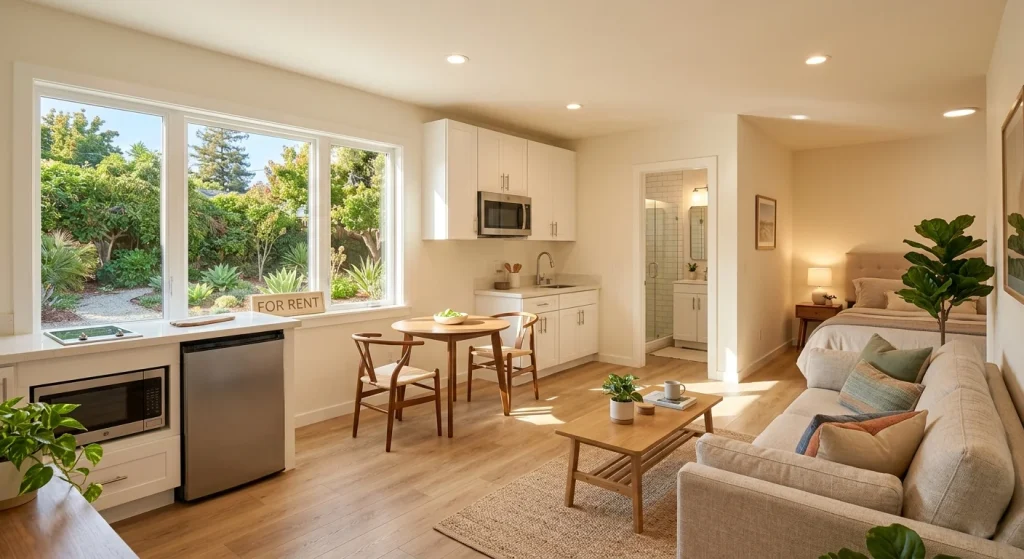
The financial case for a garage conversion ADU in Sunnyvale is compelling when viewed across a ten-year horizon.
Why Permitted ADUs Increase Property Value
- Properties with permitted ADUs are increasingly attractive to Bay Area buyers because they offer income potential from day one
- The additional legal square footage contributes to the property’s assessed improvements, which compounds long-term equity growth
- Silicon Valley’s rental demand, driven by proximity to major tech campuses and a chronically limited housing supply, keeps vacancy rates for well-located ADUs extremely low
Long-Term Financial Perspective
A garage conversion ADU in Sunnyvale is not just a construction project — it is a long-term real estate asset. The combination of:
- California’s streamlined ADU permitting framework
- Sunnyvale’s efficient ministerial review process
- Silicon Valley’s persistent rental demand
- The 15-year RSO exemption on newly created ADUs
…makes a garage conversion one of the highest-return home improvement projects available to residential property owners in Santa Clara County. The key is approaching the project with a complete understanding of the regulatory requirements, a realistic construction budget, and a licensed team that has navigated this specific path before.