
If you are a Sunnyvale homeowner looking to add more space, here is the short answer: room additions in Sunnyvale cost between $275 and $475 per square foot in 2026, depending on the type of addition, scope of work, and finish level. A standard 400 square foot bedroom addition typically runs between $110,000 and $160,000. Second story additions for 800 to 1,200 square feet range from $280,000 to $475,000 or more. These figures place Sunnyvale in the moderate to upper range of the South Bay market, sitting comfortably below premium cities like Palo Alto and Saratoga while remaining costlier than inland California markets.
With the average Sunnyvale home valued at approximately $1.8 million in 2026, expanding your existing property almost always makes more financial sense than purchasing a larger home in the same neighborhood. This guide breaks down every cost variable you need to understand before breaking ground.
Quick Cost Reference: Room Additions in Sunnyvale at a Glance
Before diving into the details, here is a snapshot of what homeowners are paying across the most common addition types in 2026:
| Addition Type | Size Range | Typical Cost Range |
| Standard Bedroom | 300 to 400 sqft | $90,000 to $160,000 |
| Master Suite | 400 to 500 sqft | $150,000 to $240,000 |
| Home Office | 200 to 300 sqft | $70,000 to $120,000 |
| Sunroom / Family Room | 250 to 400 sqft | $80,000 to $150,000 |
| Second Story Addition | 800 to 1,200 sqft | $280,000 to $475,000+ |
| Garage Conversion ADU | 250 to 600 sqft | $85,000 to $155,000 |
| Detached ADU | 400 to 1,000 sqft | $200,000 to $500,000+ |
These are total project costs including design, permits, labor, and materials. They do not reflect estimates for individual line items alone.
Why Sunnyvale Homeowners Are Choosing Room Additions Over Relocation
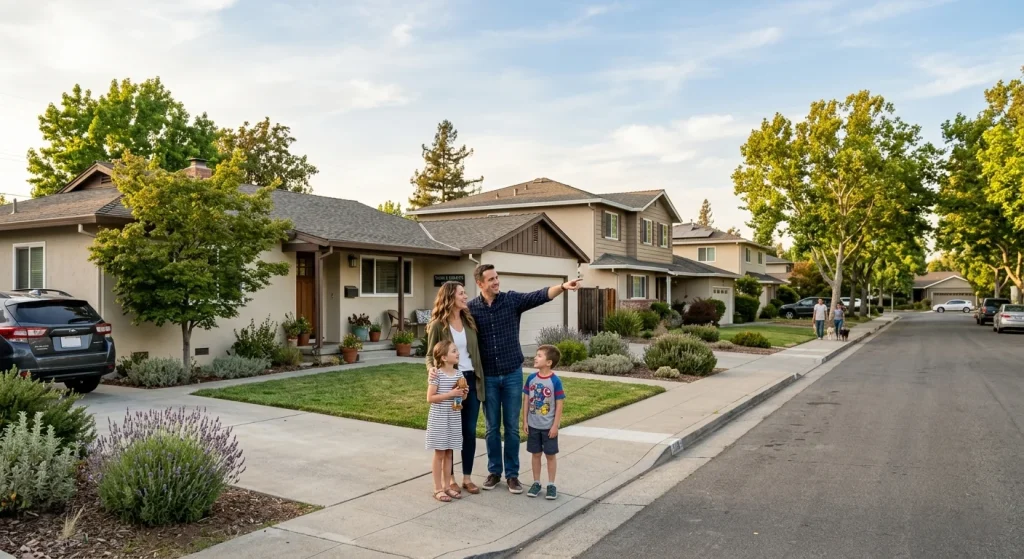
The Silicon Valley real estate market operates at a different scale than most of the country. Moving to a larger home in Sunnyvale means competing for properties priced well above the $2 million mark, absorbing high transfer taxes, and losing the equity position you have already built. A room addition, by contrast, gives you several advantages that a move simply cannot:
- You stay in your established neighborhood with existing school district access
- You avoid real estate transaction costs, which typically run 6 to 10 percent of a home’s value
- You customize the new space precisely to your household’s needs rather than adapting to someone else’s floor plan
- You preserve the low property tax base locked in under Proposition 13, which resets to current market value on a purchase
Sunnyvale’s position as a hub for companies like LinkedIn, Juniper Networks, Google, and Apple also means the local labor market for skilled construction trades is consistently active. Experienced contractors, structural engineers, and design-build firms with deep familiarity in the city’s building codes are relatively accessible compared to smaller or more remote markets. That contractor availability, combined with Sunnyvale’s relatively efficient permitting process, keeps project timelines more predictable than in many neighboring cities.
What Drives Room Addition Costs in Sunnyvale
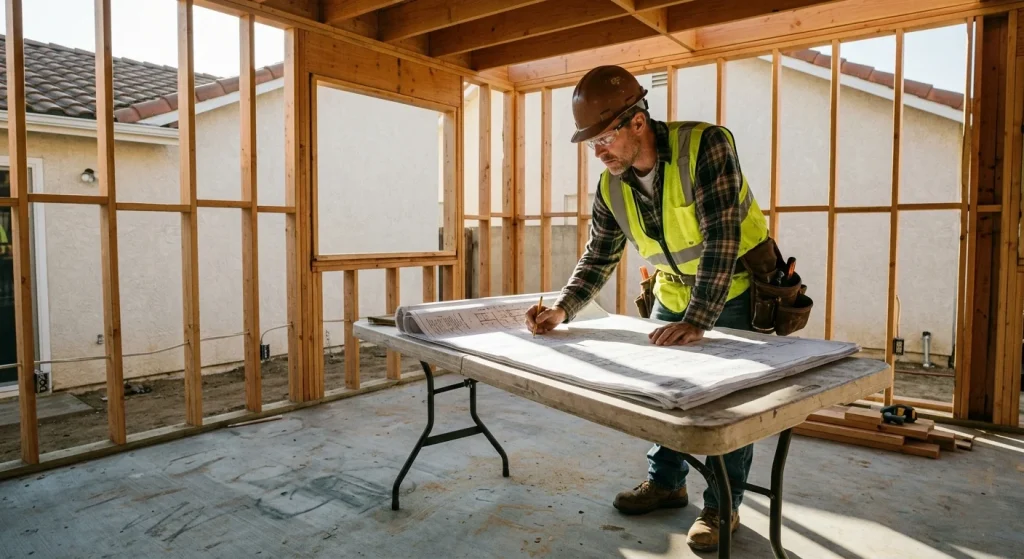
Understanding the pricing behind a room addition is not as simple as multiplying square footage by a per-foot rate. Several interconnected factors shape what you will actually pay.
Type of Addition
The structure of the addition itself is the single biggest cost variable:
- Ground floor additions expand the building footprint outward and average between $275 and $400 per square foot. These projects require new foundation work, which adds cost, but they avoid the structural reinforcement challenges of going vertical.
- Second story additions run between $350 and $475 per square foot because the existing foundation and framing must be evaluated and often reinforced to handle the additional load. Foundation reinforcement alone can add $12,000 to $30,000 to a second story project.
- Bump-outs, which extend an existing room by a few feet rather than creating a fully new addition, generally run $200 to $350 per square foot and complete faster than full room additions.
Labor Rates in the South Bay
South Bay construction labor is priced at a premium compared to the national average:
- General contractors in Sunnyvale typically charge $65 to $130 per hour for home addition work
- Framing crews, electricians, plumbers, and finish carpenters all carry Bay Area labor premiums of 30 to 50 percent above national benchmarks
- General contractors overseeing larger projects typically add 15 to 25 percent to subcontractor costs for project management, insurance, and overhead
Project Complexity and Site Conditions
Sunnyvale sits in a seismically active region of Santa Clara County, which adds mandatory engineering requirements to every addition:
- Soil conditions and proximity to the street can affect foundation design and cost
- The configuration of your existing structure, particularly load-bearing wall placement, affects how the new space connects
- Non-standard site conditions, such as sloped lots or difficult access, can add 15 to 30 percent to total project cost
Materials and Finish Level
Material choices are one of the most controllable cost levers available to homeowners:
- Entry level finishes (builder-grade flooring, standard fixtures, stock cabinetry) push costs to the lower end of each range
- Mid-range finishes (LVP or hardwood flooring, semi-custom cabinetry, standard tile) represent the most common choice for Sunnyvale additions
- Premium finishes (wide-plank hardwood, custom cabinetry, high-end HVAC zoning, Andersen or Pella windows) can push costs 20 to 40 percent above mid-range estimates
Permits and Design Fees
Soft costs are a real and significant part of every addition budget:
- Permit fees: $2,000 to $8,000 for most room additions, calculated based on project valuation
- Architectural drawings: $3,000 to $10,000 depending on project scope and complexity
- Structural engineering: $5,000 to $15,000 as a separate line item (sometimes bundled by design-build firms)
- Plan check fee: 70 percent of the building permit fee, plus 10 percent for energy compliance review
Cost Breakdown by Room Addition Type
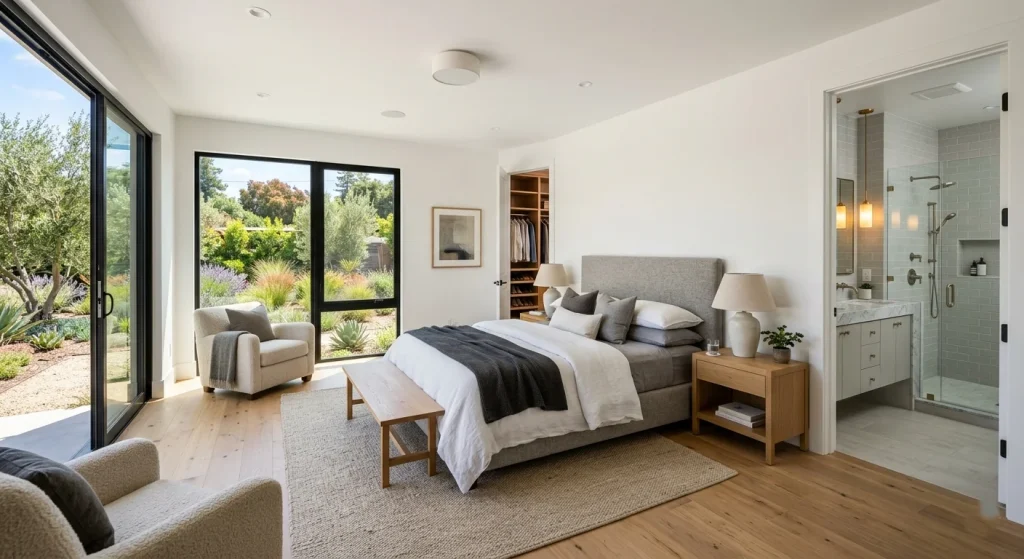
Different types of additions serve different household needs and carry very different price tags. Here is a closer look at each category.
Standard Bedroom Addition
A single bedroom addition is one of the most common projects in Sunnyvale, particularly for growing families needing to accommodate another child or a live-in relative.
- Typical size: 300 to 400 square feet
- Cost range: $90,000 to $160,000
- With en suite bathroom: Add $30,000 to $60,000 for plumbing rough-in, tile work, and fixtures
- Key considerations: Closet configuration, window placement, ceiling height, and connection to existing HVAC zones
Master Suite Addition
A primary bedroom with a walk-in closet and dedicated en suite bathroom is a more complex undertaking that delivers a meaningful upgrade to everyday living.
- Typical size: 400 to 500 square feet
- Cost range: $150,000 to $240,000
- Primary cost drivers: En suite bathroom with double vanity, walk-in shower, and soaking tub; custom closet systems; separate HVAC zone
- Best suited for: Homeowners planning to stay long term who want a genuine retreat within their own home
Second Story Addition
Adding a full or partial second story is the most impactful way to expand square footage on Sunnyvale’s characteristically modest lot sizes. Because setback requirements often limit how far you can build outward, going vertical is frequently the only path to meaningful expansion.
- Typical size: 800 to 1,200 square feet
- Cost range: $280,000 to $475,000 or more
- Primary cost drivers above ground floor work:
- Foundation reinforcement: $12,000 to $30,000
- Structural engineering assessment and design
- Temporary relocation during roof removal and framing phases
- Complete roof replacement over the existing footprint
- Timeline: 8 to 13 months from design through final inspection
Home Office Addition
Remote work has become a permanent fixture of Silicon Valley professional life, and purpose-built office additions have grown significantly in demand since 2021.
- Typical size: 200 to 300 square feet
- Cost range: $70,000 to $120,000
- Specialized systems that drive cost above a basic bedroom:
- Sound insulation between walls and ceiling
- Dedicated electrical circuits for multiple workstations
- Separate HVAC zone for temperature control during long work sessions
- Enhanced internet and low-voltage infrastructure
Accessory Dwelling Unit (ADU)
ADUs represent a distinct category of addition. Rather than expanding the primary home, an ADU creates a self-contained living unit on the same lot, complete with its own entrance, kitchen, and bathroom.
- Garage conversion ADU: $85,000 to $155,000
- Attached ADU addition: $150,000 to $350,000
- Detached new-build ADU: $200,000 to $500,000 or more
- Rental income potential in Sunnyvale (2026): $2,000 to $3,600 per month depending on size and neighborhood
- Why homeowners choose ADUs: Multigenerational living, rental income to offset mortgage costs, and the fact that ADU rental potential is increasingly factored into buyer valuations at resale
Sunroom or Family Room Addition
Adding informal living and gathering space through a sunroom or expanded family room offers strong quality-of-life benefits at a relatively moderate cost.
- Typical size: 250 to 400 square feet
- Cost range: $80,000 to $150,000
- Key variables: Glazing specification and thermal performance (California’s energy efficiency standards require careful window selection), connection to existing living areas, and HVAC integration
Building Up Versus Building Out: The Real Cost Difference
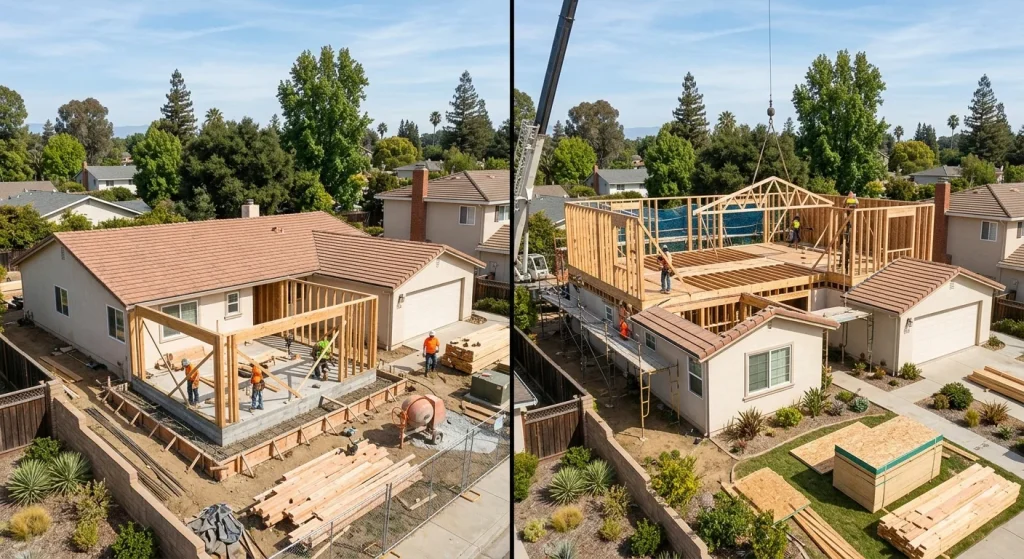
One of the first decisions Sunnyvale homeowners face is whether to expand horizontally or vertically. The choice affects both cost and lifestyle considerably.
Building Out (Ground Floor Addition)
Advantages:
- More straightforward construction process
- Less disruption to existing living areas during construction
- Integrates naturally with single-level living, which many Sunnyvale homeowners value
- Lower per-square-foot cost ($275 to $400 versus $350 to $475 for second story)
Disadvantages:
- Requires new foundation work, including excavation and concrete
- Reduces yard or outdoor living space
- May be constrained by setback requirements, lot coverage limits, and easements
- Alters interior traffic patterns and may affect existing rooms
Building Up (Second Story Addition)
Advantages:
- Maximizes square footage without reducing yard space or violating setback limits
- Often the only practical option on smaller Sunnyvale lots
- Doubles living area potential within the existing footprint
Disadvantages:
- Higher per-square-foot cost due to structural reinforcement requirements
- Foundation and first-floor framing must be assessed and often upgraded
- More disruptive during construction, sometimes requiring temporary relocation
- Longer timeline: 8 to 13 months versus 5 to 9 months for ground floor additions
In Sunnyvale’s zoning landscape, where lot coverage limits frequently constrain outward expansion, second story additions have become the most common path for homeowners who need substantial new space.
Navigating Sunnyvale’s Permit Process for Room Addition
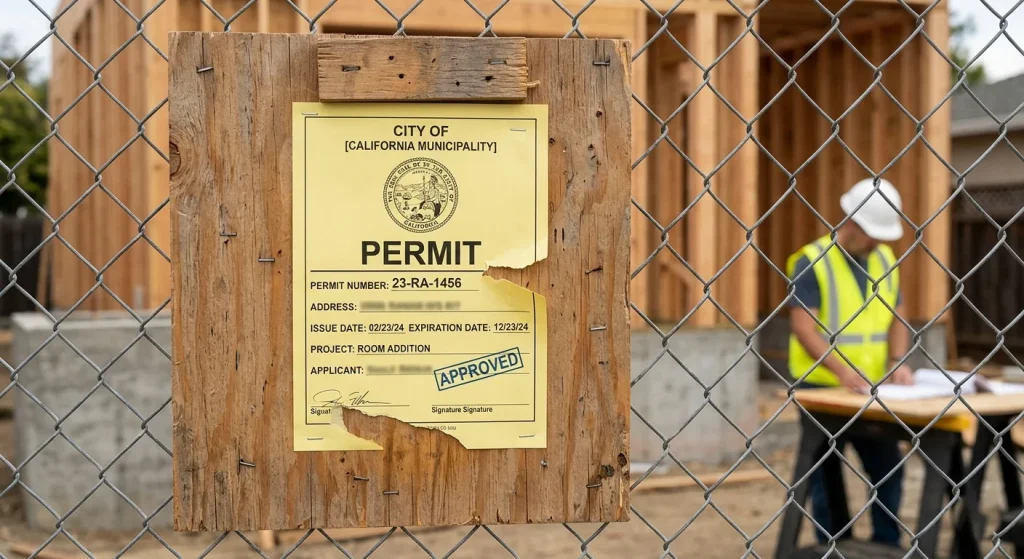
Every room addition in Sunnyvale requires a building permit. Understanding how the local process works helps set realistic expectations for both timeline and cost.
How the Process Works
- Submission: Plans are submitted to Sunnyvale’s Building Division through the One-Stop Permit Center at 456 West Olive Avenue, with online submission and tracking available
- Plan review: Initial review takes 10 to 15 days for standard additions under normal conditions
- Correction cycles: Projects that receive plan check comments require resubmission, with each cycle adding 10 to 15 days
- Permit issuance: Fees are paid and the building permit is issued once plans are approved
- Inspections: Required at each phase of construction (foundation, framing, rough mechanical, insulation, and final)
Permit Fees Explained
Sunnyvale’s building permit fees are calculated based on project valuation:
- Minimum permit fee: $157 for projects valued at $1,000 to $2,000
- Plan check fee: 70 percent of the building permit fee
- Energy plan check: 10 percent of the building permit fee
- Total permit costs for most room additions: $2,000 to $8,000
When a Special Development Permit Is Required
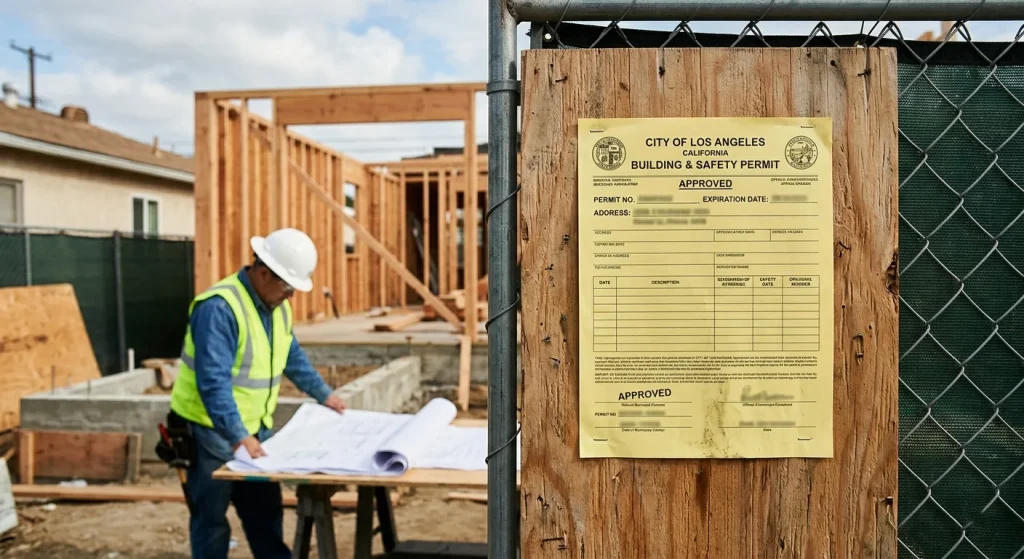
Most standard residential additions do not require a formal design review board hearing, which gives Sunnyvale a processing advantage over cities like Cupertino and Mountain View. However, a Special Development Permit reviewed by the Planning Commission may be required when:
- The addition exceeds height thresholds for the residential zone
- Lot coverage after construction exceeds the maximum allowed percentage
- The project is located in a designated neighborhood overlay zone
Knowing whether your project triggers these thresholds before design begins can save significant time and cost.
How Seismic Requirements Affect Room Addition Costs in Sunnyvale
California’s seismic environment is not a background consideration in Sunnyvale home construction. It is an active cost driver with mandatory compliance requirements under the 2025 California Building Code and 2025 California Residential Code.
What Seismic Compliance Involves
For ground floor additions:
- Soil assessment to confirm bearing capacity
- Foundation design meeting current seismic standards
- Load-bearing wall modifications that account for the new structural configuration
- Proper connections between the new addition and the existing structure
For second story additions:
- Structural engineering assessment of the existing foundation’s capacity for additional load
- First-floor framing reinforcement, often including new shear walls
- Holdown anchors and foundation bolting where deficiencies are identified
- Complete re-engineering of load paths through the structure
Budget Expectations for Seismic Work
- Structural engineering fees: $5,000 to $15,000 as a separate project cost
- Foundation reinforcement for second story additions: $12,000 to $30,000
- Seismic retrofitting of existing structure, if triggered: $8,000 to $25,000 additional
Some design-build firms include engineering in their bundled pricing. Confirm explicitly whether engineering is included or quoted separately when reviewing contractor proposals.
Comparing Sunnyvale Room Addition Costs to Nearby Cities
Understanding Sunnyvale’s position in the regional market helps you evaluate whether a contractor quote is competitive.
| City | Typical Cost per Square Foot | Permit Speed | Design Review Required |
| Palo Alto | $400 to $650 | Slower | Yes, most projects |
| Saratoga | $400 to $600 | Moderate | Yes, many projects |
| Cupertino | $350 to $500 | Moderate | Yes, many projects |
| Sunnyvale | $275 to $475 | Fast (10 to 15 days) | No, most projects |
| Mountain View | $275 to $450 | Moderate | Sometimes |
| Santa Clara | $250 to $425 | Moderate | Rarely |
| San Jose | $250 to $400 | Varies | Rarely |
For most additional types, Sunnyvale sits in the middle of the South Bay market: faster permitting than premium cities, no mandatory design review for most projects, strong contractor availability, and costs that are elevated relative to national averages but manageable within the context of local real estate values.
Financing a Room Addition in Sunnyvale
Most Sunnyvale homeowners carry substantial equity given appreciation in local real estate over the past decade. That equity is typically the most practical funding source for a large construction project.
Common Financing Options
Home Equity Line of Credit (HELOC)
- Current rates: 7.5 to 8.5 percent
- Funds are drawn as needed throughout construction rather than in a lump sum
- Works well for additions because construction payments are staged over months
- Best for homeowners who want flexible access and have strong credit
Home Equity Loan
- Current rates: 7 to 8 percent
- Fixed lump sum at a fixed rate provides predictable monthly payments
- Best for homeowners who prefer certainty and have a well-defined project scope
Cash Reserves
- Eliminates interest costs entirely
- Simplest structure with no lender involvement or approval process
- Best for homeowners with liquidity who want to avoid carrying debt
ADU-Specific Financing
- Some lenders offer products designed specifically around ADU rental income potential
- Underwriting may factor projected rental income into debt-to-income calculations
- Best for homeowners whose primary goal is generating rental revenue
A Note on Cost Overruns
Vague contractor quotes and scope changes during construction are the most common sources of financial stress in addition projects. Working with firms that provide itemized estimates and fixed-price contracts through a structured design phase significantly reduces this risk. Always have a 10 to 15 percent contingency reserve on top of your stated project budget before drawing financing.
What Sunnyvale Room Additions Do for Your Home’s Value
A room addition is fundamentally a lifestyle investment, but it carries meaningful implications for resale value in a market where square footage commands significant premiums.
How Additions Affect Resale Value
- Bedroom count is a primary search filter for buyers in Sunnyvale. A three-bedroom home and a four-bedroom home do not compete for the same buyers, and the price gap between those configurations is substantial in a market with median values above $1.8 million.
- Permitted additions add appraised square footage that both lenders and buyers count. Unpermitted additions, by contrast, can reduce a home’s value or create complications during the sale process.
- ADUs increasingly affect buyer calculations because rental income potential is now a standard part of how sophisticated buyers evaluate South Bay properties. A well-built ADU renting for $2,500 per month adds $30,000 in annual gross income, which at South Bay capitalization rates represents a material contribution to property value.
What to Watch Out For
Not every addition pays for itself in resale. Projects that create problems at the value level include:
- Additions that are overbuilt relative to surrounding homes in the neighborhood
- Materials dramatically out of sync with the existing structure’s character and finish level
- Floor plan configurations that create awkward traffic flow or eliminate valued outdoor space
- Work done without permits, which triggers disclosure obligations and buyer concerns
The most financially sound additions serve genuine household needs, integrate naturally with the existing structure, and are built with quality that holds up over a 10 to 20 year horizon.
How to Choose the Right Contractor for a Sunnyvale Room Addition
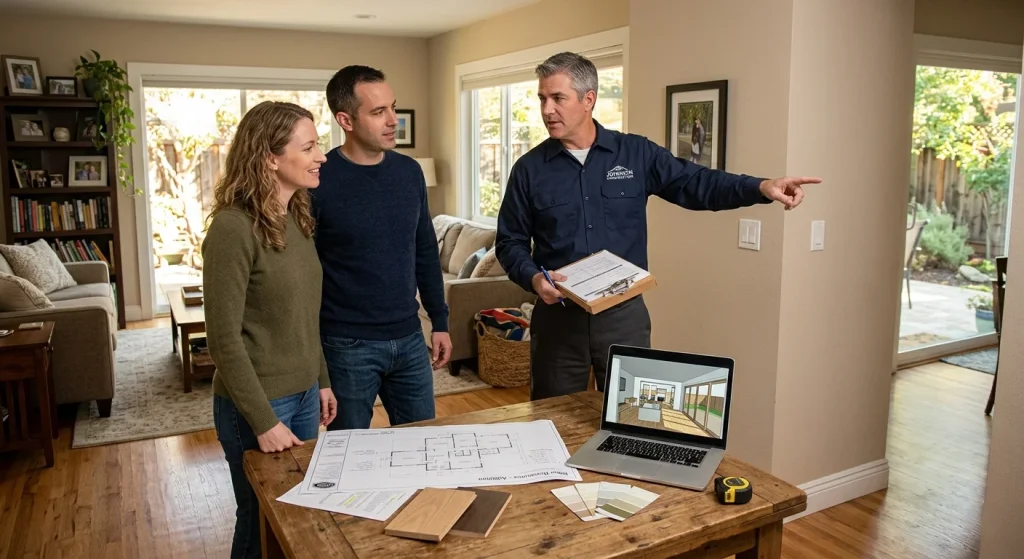
The contractor you hire for a room addition will be in your life for 6 to 13 months. That relationship deserves serious evaluation before you sign anything.
Non-Negotiable Verification Steps
Before engaging any contractor seriously:
- Confirm a valid California State License Board (CSLB) license and check its status at cslb.ca.gov
- Verify active general liability insurance (minimum $1 million per occurrence is standard)
- Confirm active workers compensation coverage for all employees and subcontractors
- Check online reviews across multiple platforms, not just the contractor’s own website
What to Look for in Proposals
- Itemized written estimates, not lump sum quotes. Line-item detail lets you make informed decisions about scope and material substitutions.
- Fixed-price contracts or clearly defined allowances for finish selections to prevent open-ended cost exposure
- Clear change order processes documented in writing before work begins
- Construction schedule with milestones tied to payment draws
Red Flags to Watch For
- Bids dramatically lower than other competitive quotes almost always reflect missing scope or a plan to recover margin through change orders
- Contractors who pressure you to sign quickly without adequate time for design development
- Proposals that lack permit costs, engineering fees, or site preparation in the total
- Reluctance to provide references from completed Sunnyvale or South Bay projects
Design-build firms that handle architecture, engineering, permitting, and construction under a single contract simplify the coordination process considerably. A phased contract that covers design and permitting separately from construction gives you a decision point before committing to the full build cost.
Planning Your Room Addition Project: A Realistic Timeline
One of the most common misconceptions Sunnyvale homeowners have about room additions is how quickly they can move from idea to finished space. Here is an honest sequence.
Phase by Phase Breakdown
Phase 1: Design and Engineering (6 to 12 weeks)
- Initial design consultations and space planning
- Architectural drawings and structural engineering
- 3D visualization (offered by many design-build firms)
- Preparation of permit-ready plan set
Phase 2: Permit Submission and Review (6 to 10 weeks)
- Submission to Sunnyvale’s Building Division
- Initial plan review: 10 to 15 days
- Correction cycles if required: additional 10 to 15 days per cycle
- Permit issuance and fee payment
Phase 3: Construction (3 to 7 months depending on addition type)
- Ground floor additions: 3 to 5 months of active construction
- Second story additions: 5 to 7 months of active construction
- Required inspections at foundation, framing, rough mechanical, insulation, and finish stages
Phase 4: Completion (2 to 4 weeks)
- Final inspection by Sunnyvale Building Division
- Certificate of occupancy issuance
- Punch list completion and project closeout
Total Project Timelines
- Ground floor room addition: 6 to 9 months from first meeting to move-in
- Second story addition: 10 to 14 months from first meeting to move-in
Homeowners who build these timelines into their planning from the start tend to have a considerably smoother experience than those who begin expecting a faster process.
Getting the Most Out of Your Room Addition Investment
A room addition in Sunnyvale is one of the most consequential decisions a homeowner can make. The investment is substantial, the process is complex, and the result becomes a permanent part of your home. But for families who need more space and love where they live, adding on is almost always the better financial and practical answer compared to relocating within Silicon Valley’s current market.
The most successful projects consistently share the same foundation:
- A clear, honest understanding of what the household genuinely needs, not just what would be nice to have
- A realistic budget established before design begins, with a 10 to 15 percent contingency built in
- A contractor selected for quality, communication, and verified local experience, not for the lowest opening bid
- Patience with a permit process that, while efficient by Bay Area standards, still requires real calendar time
- A permit-compliant design that integrates structurally and aesthetically with the existing home
Get those elements right, and a Sunnyvale room addition delivers both the space your family needs today and a material, lasting improvement to one of your most valuable financial assets.