
If you own a small bathroom in a Sunnyvale home, the good news is that you have more renovation potential than you might think. The most effective small bathroom renovation ideas for Sunnyvale homes include:
- Installing floating vanities and wall-mounted fixtures to free up floor space
- Converting bathtubs to curbless, frameless showers for an open feel
- Using large-format tiles to reduce visual clutter and grout lines
- Adding recessed niches and wall-mounted storage within the existing footprint
- Upgrading to WaterSense-certified and smart fixtures for California code compliance
- Introducing layered lighting to add depth and perceived space
These strategies work especially well in the compact 40 to 60 square foot bathroom footprints common in Sunnyvale’s Birdland, Cherry Chase, and Lakewood Village neighborhoods, where postwar ranch homes dominate the housing stock.
Why Small Bathroom Renovations Matter More in Sunnyvale Than Almost Anywhere Else
Sunnyvale sits at the heart of Silicon Valley, where the median home value has surpassed $2 million. In a real estate market this competitive, buyers and appraisers pay close attention to every square foot. A well-executed bathroom renovation in Sunnyvale is not just a cosmetic upgrade. It is a financial decision with measurable returns.
Kitchens and bathrooms consistently deliver the highest individual return on investment, and a cohesive, updated home in this market can recoup 60 to 80 percent of renovation costs at resale.
What Makes Sunnyvale Bathrooms Different from the National Average
The housing stock is the key factor that separates Sunnyvale renovations from what you read about in national guides. The majority of residential properties here were built between the 1950s and 1970s as part of the postwar boom that transformed Santa Clara Valley. These ranch-style homes were functional, but their bathrooms were rarely generous in size.
When walls come open during a renovation in these older neighborhoods, contractors commonly find:
- Original tile installed directly over standard drywall instead of cement board or a waterproof substrate
- Galvanized steel supply lines that require replacement when encountered
- Cast-iron drain pipes that limit plumbing relocation options
- Slab-on-grade foundations that require concrete cutting for any drain repositioning
- Pre-1978 materials that may trigger asbestos or lead paint testing requirements
Understanding these conditions before you start is not optional. It is what separates a smooth renovation from a budget-busting one.
Sunnyvale Permit Requirements You Need to Know Before You Start
The City of Sunnyvale Building Division requires a permit for any full bathroom remodel. As of permits submitted on or after January 1, 2026, projects are governed by the 2025 California Building Code, the 2025 California Plumbing Code, the 2025 California Electrical Code, and CalGreen sustainability standards.
A full remodel permit is triggered when two or more of the following are updated:
- Remodeling or replacing the tub and/or shower
- Replacing the vanity and sink
- Moving outlets or doing electrical work
- Moving a toilet
- Installing an exhaust fan
- Installing or changing out a window
Budgeting $800 to $2,000 for permits on a standard project is a realistic starting point.
The Compact Bathroom Challenge Specific to Sunnyvale Ranch Homes
Before exploring specific renovation ideas, it helps to understand the spatial reality of most Sunnyvale bathrooms. A typical full bath in a postwar ranch home covers 40 to 60 square feet. Guest baths are often smaller. These layouts were designed for an era when functionality came before comfort, and the standard tub-toilet-vanity arrangement leaves little room for movement or storage.
Should You Expand the Footprint or Work Within It?
Many homeowners ask whether expanding the footprint is an option. It is, but expanding requires moving walls, which triggers a structural review and broadens the permit scope considerably. Labor rates for licensed tradespeople in Santa Clara County already run 25 to 40 percent above national averages. Adding structural work compounds both cost and timeline significantly.
For most Sunnyvale homeowners, the smarter path is to work within the existing footprint and use the design strategies below to make the space feel larger, more functional, and more visually appealing than its square footage suggests.
Floating Vanities and Wall-Mounted Fixtures: The Single Biggest Space Gain
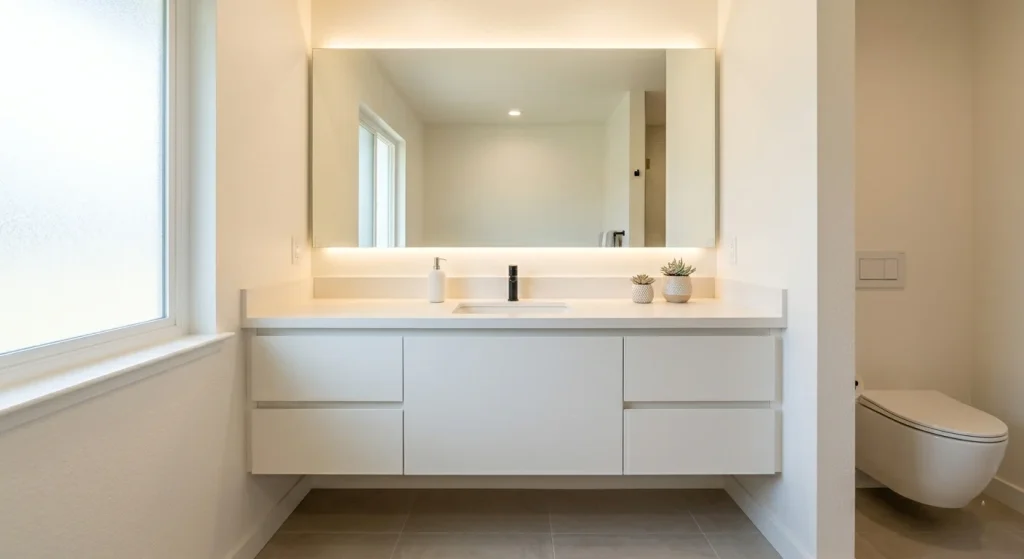
One of the most impactful changes you can make in a small Sunnyvale bathroom is replacing a floor-mounted vanity with a wall-hung version. When the floor runs continuously beneath the vanity, the eye reads the room as larger than it is. The exposed floor space also makes cleaning far easier, which is a practical benefit that shows up in everyday use rather than just at resale.
Why Wall-Mounted Fixtures Work So Well in Small Bathrooms
- Floating vanities create the illusion of a larger floor plan by keeping the sightline unbroken from wall to wall
- Wall-mounted toilets move the tank into the wall cavity, recovering four to six inches of depth in the toilet zone — inches that feel significant in a 50 square foot room
- Corner sinks are ideal for compact powder rooms or half baths, positioning the fixture where floor space would otherwise go unused and freeing up wall space for storage or a larger mirror
Paired together, a wall-hung vanity and a wall-mounted toilet can make a small Sunnyvale bathroom feel closer in character to a boutique hotel bathroom than a 1960s ranch house. This combination also positions the home more favorably in the Silicon Valley resale market, where buyers distinguish quickly between builder-grade updates and genuinely considered design.
Tub-to-Shower Conversions: The Most Popular Renovation Choice in Silicon Valley
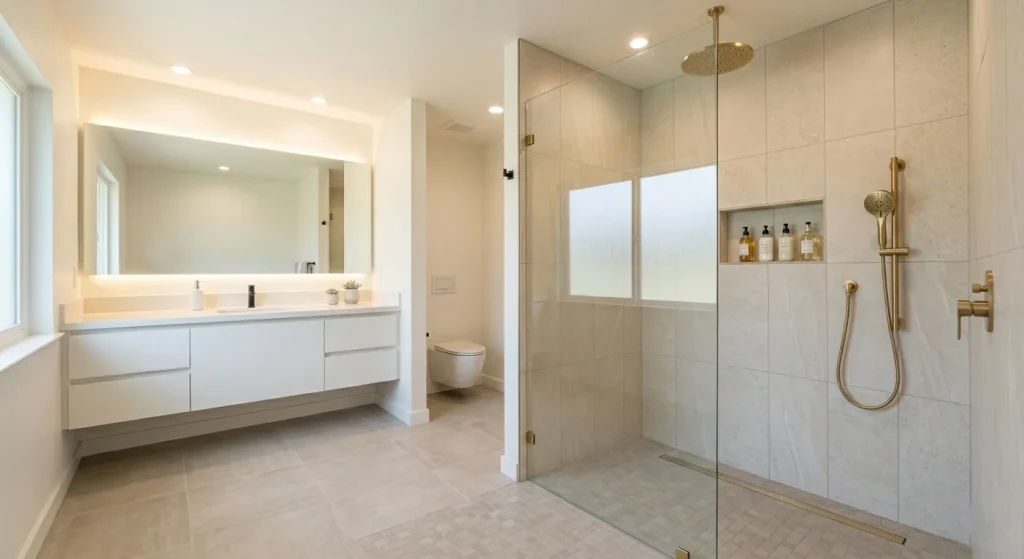
Across Silicon Valley and the broader Bay Area, the tub-to-shower conversion has become the dominant renovation choice for small bathrooms, and for good reason. A standard 60-inch bathtub takes up roughly the same footprint as a 36 by 60 inch shower, but the shower feels significantly more spacious because it eliminates the visual bulk of the tub surround.
Choosing the Right Shower Design for a Sunnyvale Home
Curbless or barrier-free shower entries are particularly popular in Sunnyvale homes because they serve multiple purposes at once:
- The absence of a threshold opens sightlines from the doorway, making the entire bathroom feel more open
- They support aging-in-place design principles, which matter in a city where many long-term homeowners plan to stay in their homes well into their retirement years
- California’s building codes increasingly accommodate this approach, and local contractors are experienced with the waterproofing requirements it demands
Frameless glass enclosures are strongly preferred over framed alternatives in small bathrooms:
- The absence of a metal frame keeps the eye moving through the space rather than stopping at a visual boundary
- Frameless glass reads as a premium finish in Sunnyvale’s competitive resale environment
- Buyers who have toured enough renovated homes in this market can immediately distinguish between builder-grade and thoughtfully designed work
Tile Selection and Layout: How Surfaces Shape the Perception of Space
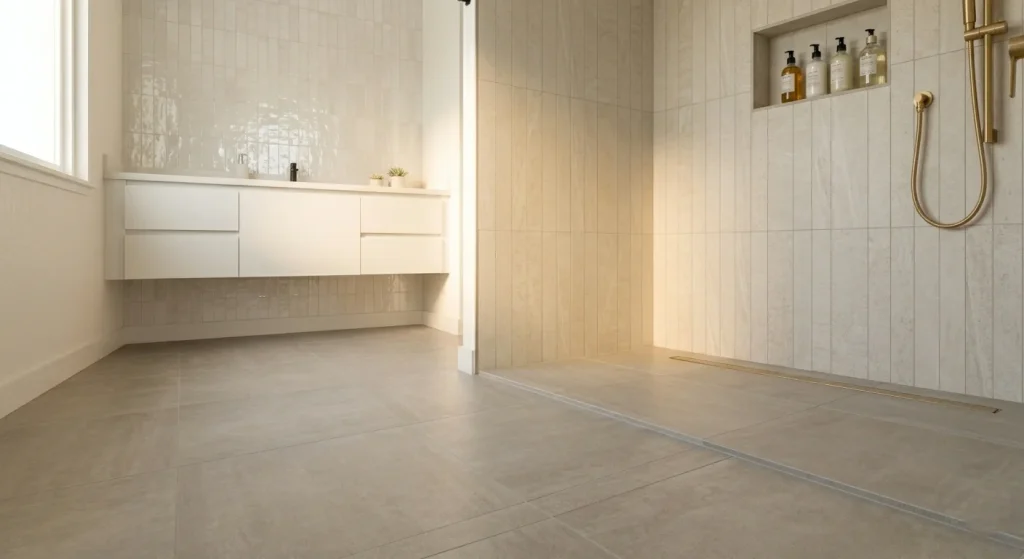
Tile choices carry more weight in a small bathroom than almost any other material decision. The relationship between tile size, grout line count, and spatial perception is well documented in design practice, and it applies directly to Sunnyvale’s compact bathrooms.
Best Tile Strategies for Small Sunnyvale Bathrooms
Large-format tiles (24 by 24 inches or larger) reduce the number of grout lines visible in a space, which creates a calmer and more expansive reading of the room. This is particularly effective on floors, where a continuous surface with minimal interruption gives the eye room to travel.
Popular tile choices among Sunnyvale homeowners include:
- Rectified porcelain in a matte or stone-look finish that references the warm California aesthetic
- Large-format marble-look porcelain for a high-end appearance at a manageable cost
- Zellige-style or handmade-look tiles used as a single accent wall to introduce texture without overwhelming the space
- Textured wall panels that reference wood grain or natural stone for warmth and biophilic connection
Vertical tile layouts on shower walls draw the eye upward and create the impression of greater ceiling height. In bathrooms with standard 8-foot ceilings, the minimum under current Sunnyvale building code, running tile vertically rather than horizontally adds perceived height without changing a single structural element.
Smart Storage Solutions That Work Within Small Footprints
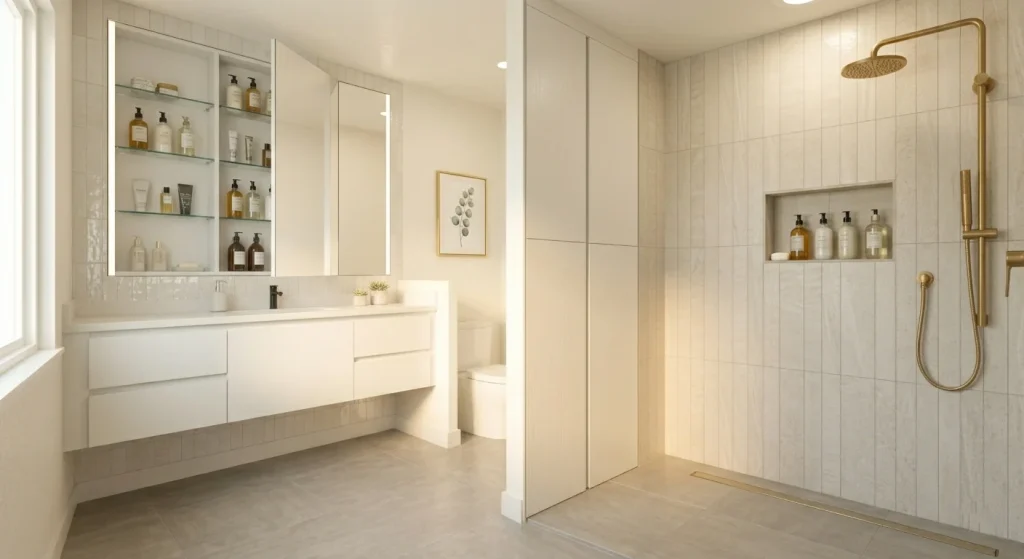
Storage is the chronic problem in small Sunnyvale bathrooms. Original ranch-home designs offered minimal built-in storage, and adding a linen closet is rarely possible without structural changes. The most effective approach combines several strategies that work at different scales and use space that would otherwise go to waste.
The Best Storage Upgrades for Small Sunnyvale Bathrooms
Recessed medicine cabinets are among the highest-value storage additions available:
- They use wall cavity space that would otherwise remain empty
- Their mirrored fronts serve double duty as storage and light-reflecting surfaces
- A well-chosen recessed cabinet replaces a flat mirror while adding meaningful storage depth without projecting into the room at all
Shower niches built into the wall between studs deliver clean, integrated storage:
- They hold shampoo, soap, and razors without requiring a caddy that disrupts the visual cleanliness of the shower
- Tile-lined niches are now included as a standard element in most quality Sunnyvale renovations rather than a luxury upgrade
Tall, narrow cabinets take advantage of vertical space that often goes unused:
- Position them between the toilet and the wall, or beside the vanity
- In a bathroom where the floor footprint cannot expand, height becomes the primary available resource
- Cabinet designs that reach toward the ceiling use that resource effectively and add significant visual interest to the space
Over-toilet shelving and floating wall shelves in the vanity zone are lower-cost additions that make a meaningful organizational difference without requiring structural work or permits.
Lighting Design for Small Bathrooms: Layered, Strategic, and Code-Compliant
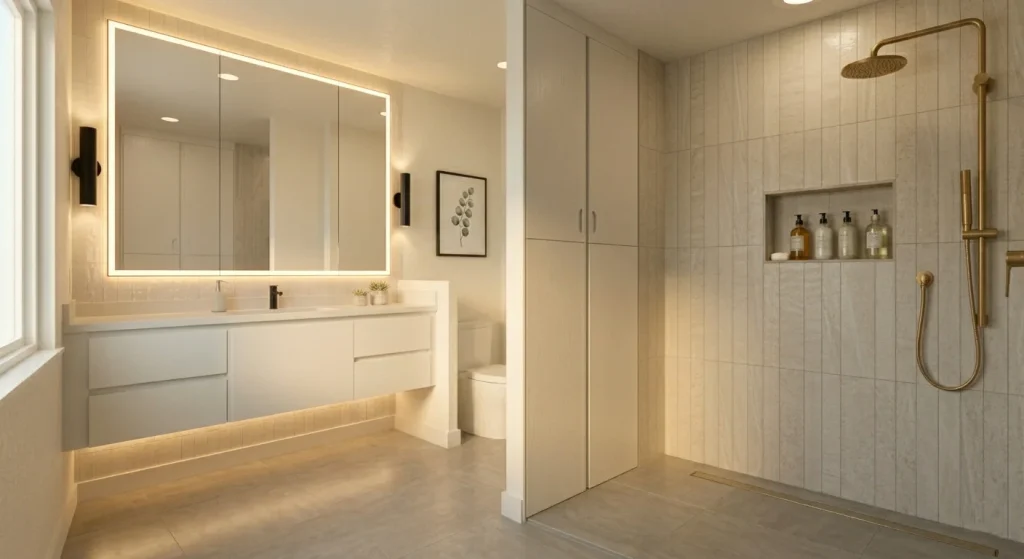
Lighting transforms small spaces more than almost any other single element. In a compact Sunnyvale bathroom, a single overhead fixture creates shadows that flatten the room and make it feel smaller than it is. A layered lighting approach gives the space dimension, warmth, and genuine functionality.
How to Layer Lighting in a Small Bathroom
A complete lighting plan for a small Sunnyvale bathroom includes three distinct layers:
- Overhead ambient lighting using recessed LED fixtures on a dimmer switch for general illumination
- Vanity task lighting through side-mounted sconces at eye level or LED strips integrated into a backlit mirror, which reduce facial shadows during grooming
- Accent or toe-kick lighting that adds depth and a spa-like ambiance during evening use
Backlit mirrors and LED mirror frames are especially popular in Silicon Valley renovations because they combine functional lighting with a clean, modern aesthetic that requires no additional wall fixtures.
Dimmable circuits allow the same bathroom to function as a bright, task-oriented morning space and a softer, more relaxing evening environment. This flexibility is particularly valuable in smaller bathrooms where the space must serve multiple purposes throughout the day.
California Title 24 Lighting Compliance
California’s Title 24 Energy Code governs lighting in residential renovations. Projects submitted under the 2025 code require fixtures that meet current efficiency standards. LED technology meets and exceeds those requirements while delivering the color rendering and dimming performance that design-conscious homeowners want. Projects submitted for permits after January 1, 2026 should also budget an additional 5 to 10 percent on HVAC and ventilation scope to align with the updated mechanical ventilation requirements.
Natural light is the most powerful lighting resource of all. Where structural constraints allow, consider:
- A solar tube for interior bathrooms without exterior walls, flooding the space with daylight
- A small skylight positioned to maximize Sunnyvale’s generous sun exposure year-round
- Translucent window glazing that introduces light while maintaining privacy on street-facing walls
Water Efficiency and Smart Fixtures: California Compliance Meets Everyday Convenience
California’s water efficiency regulations are among the most rigorous in the country, and Sunnyvale homeowners renovating their bathrooms need to plan around them. WaterSense-certified fixtures are designed to meet EPA efficiency standards without sacrificing performance, and in California many of these fixtures are not just a preference but a code requirement.
Water-Efficient Fixtures for Sunnyvale Bathrooms
Every small bathroom renovation in Sunnyvale should include the following water-efficient upgrades:
- Low-flow toilets or dual-flush valves that deliver strong flush performance at significantly reduced water consumption
- WaterSense-certified showerheads rated at a maximum of 2.0 gallons per minute, well below the older 2.5 gallon per minute standard
- Flow-restricted faucets that reduce daily consumption without affecting usable water pressure
Smart Fixture Options Worth Considering
The tech-forward sensibility of Silicon Valley’s residents has made connected home upgrades a natural fit for Sunnyvale bathroom renovations:
- Touchless faucets with sensor activation reduce water waste from running taps and improve hygiene, integrating cleanly into minimalist vanity designs
- Smart shower systems with temperature presetting and volume control through a wall panel or mobile app add daily convenience for high-traffic households
- Smart mirrors with integrated lighting, defog functions, and Bluetooth connectivity serve multiple functions in compact spaces where every fixture needs to earn its place
Mirrors, Reflective Surfaces, and the Architecture of Visual Expansion
In a small bathroom, mirrors are not decorative. They are structural in the way they shape the experience of the space. Understanding how reflective surfaces manipulate perceived size is one of the most useful tools available in a small bathroom renovation.
How to Use Mirrors and Reflective Surfaces Strategically
- A mirror that extends from the countertop to the ceiling reflects the full height of the room, making both the vanity zone and the space behind you feel dramatically larger
- Edge-to-edge mirrors covering an entire vanity wall eliminate the visual boundaries that define a room’s narrowness
- Frameless mirrors are consistently preferred over framed options because they eliminate the visual weight of the frame, allowing the eye to read open space until it reaches the mirror’s edge
- Polished porcelain floor tiles, glass subway tiles in the shower, and high-gloss painted ceilings all bounce light deeper into the room than their matte counterparts, effectively amplifying available natural and artificial light
In bathrooms where natural light is limited, this light amplification strategy makes a measurable difference in how the space feels at any time of day.
Color Palettes and Material Combinations That Work in Silicon Valley Homes
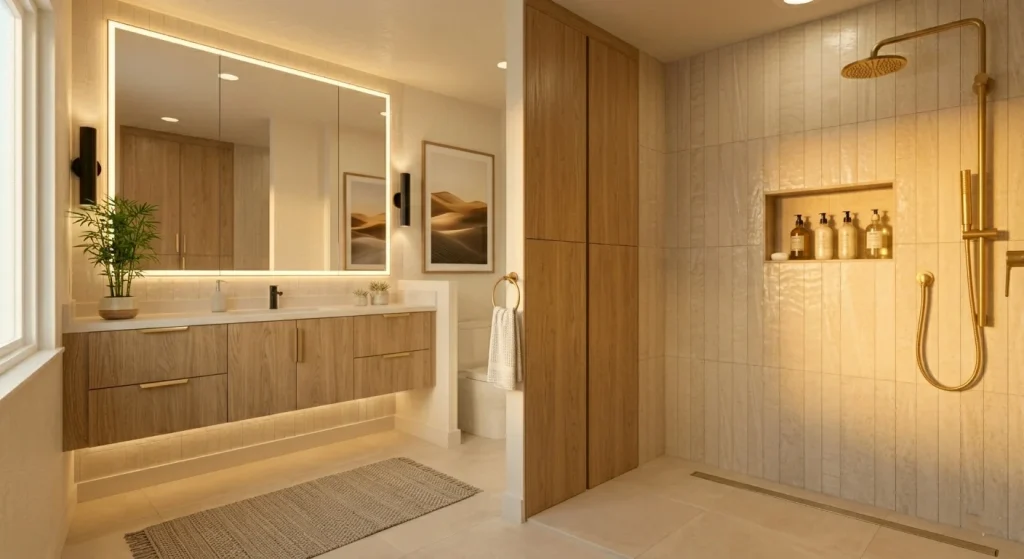
Sunnyvale’s architectural character sits at the intersection of California casual and Silicon Valley modern. The renovation aesthetic that resonates most in this market combines clean lines, warm natural materials, and a neutral color palette that feels timeless rather than trend-dependent.
The Right Colors for Small Sunnyvale Bathrooms
Light, warm neutrals remain the dominant color choices for small bathroom walls and tile in Sunnyvale renovations:
- Soft whites and off-whites for walls and large-format floor tile
- Greiges and warm grays for a sophisticated neutral that photographs well for resale listings
- Pale sand and warm taupe tones that complement the California indoor-outdoor aesthetic
- Accent colors through matte black hardware, brushed gold fixtures, or a single dark-toned niche tile for visual contrast without darkening the room
Material Choices That Resonate With Sunnyvale Buyers
Natural materials have become a consistent element in high-quality Sunnyvale renovations:
- Teak or bamboo vanity accessories and bath accessories
- Stone-look porcelain tile that delivers the aesthetic of marble or travertine at a fraction of the maintenance cost
- Textured wall panels referencing wood grain for warmth and biophilic character
Hardware and fixture finishes have shifted significantly in recent years:
- Matte black offers strong graphic contrast against light tile and soft neutrals and reads as contemporary
- Brushed nickel provides a versatile warm-neutral finish that complements both cool and warm color palettes
- Brushed gold and unlacquered brass work well with warmer tile palettes and the California-influenced design sensibility common in Sunnyvale homes
- Chrome now reads as dated in most renovation contexts and is best avoided in any project targeting resale appeal
What a Small Bathroom Renovation Actually Costs in Sunnyvale
Cost is the practical foundation of any renovation conversation, and in Sunnyvale it requires local context rather than national averages.
Sunnyvale Bathroom Renovation Cost Ranges (2025 to 2026)
| Renovation Scope | Estimated Cost Range |
| Cosmetic facelift (surface finishes only) | $8,000 to $15,000 |
| Mid-range full remodel | $25,000 to $45,000 |
| High-end or full custom renovation | $45,000 to $65,000+ |
| Permit and plan check fees | $800 to $2,000 |
| Asbestos/lead paint testing (if required) | $300 to $800 |
| Abatement costs (if hazardous materials found) | $1,500 to $8,000 |
What Drives Cost Variation in Sunnyvale
Several factors push a Sunnyvale renovation toward the higher end of these ranges:
- Labor premiums: Skilled tile setters, licensed plumbers, and finish carpenters in Santa Clara County price 25 to 40 percent above national averages
- Older housing stock conditions: Galvanized pipes, tile-over-drywall wet areas, and slab foundations add discovery and remediation costs that cannot always be anticipated before demolition begins
- Permit scope: Projects that move plumbing, touch electrical, or open walls require inspections at multiple phases, adding both time and coordination cost
- Fixture and material selections: The gap between standard and premium finishes is wide, and material choices drive significant variation in total project cost
A surface-level renovation that updates finishes without relocating plumbing or electrical typically runs five to eight working days. A more comprehensive scope involving fixture relocation and layout changes takes considerably longer.
Choosing the Right Contractor for a Sunnyvale Bathroom Renovation
The contractor relationship is more consequential in Sunnyvale than in lower-stakes markets because the permit environment, the age of the housing stock, and the cost of mistakes all create higher risk.
What to Look for When Hiring a Sunnyvale Bathroom Contractor
- California Contractors State License Board (CSLB) license, verifiable through the CSLB’s online database
- Experience with Sunnyvale’s specific housing stock, particularly the postwar ranch homes of Cherry Chase, Birdland, and Lakewood Village
- A contractor who pulls permits in their own name, not in the homeowner’s name as an owner-builder
- Detailed bids that break down labor and materials separately, making it possible to compare proposals accurately
- Local references from completed projects in Sunnyvale or neighboring Santa Clara County communities
Why Permits Must Never Be Skipped
In Sunnyvale’s real estate market, buyers and their agents scrutinize permit history carefully. Unpermitted work creates real problems at resale that can cost far more to resolve than the permit would have. A contractor who suggests skipping the permit is not saving you money. They are transferring legal and financial risk onto you.
Planning Your Small Bathroom Renovation From Start to Finish
The sequence of a small bathroom renovation in Sunnyvale follows a consistent pattern regardless of the specific scope. Getting this sequence right prevents the expensive surprises that derail projects mid-construction.
The Step-by-Step Renovation Sequence
Phase 1: Planning and Design
- Define your goals, budget, and must-have features before contacting contractors
- Make all design decisions, including fixture selections, tile choices, vanity dimensions, and lighting placement, before demolition begins
- Order materials or confirm delivery schedules so everything is on-site before work starts
Phase 2: Permitting
- Obtain permits through the City of Sunnyvale Building Division before any work begins
- Take photographs of the entire existing bathroom configuration before demolition, as required by the Building Division for the first inspection
- Allow one to three business days of lead time for each required inspection
Phase 3: Construction The renovation moves in a predictable sequence:
- Demolition and removal of existing fixtures and finishes
- Rough plumbing relocation or upgrade
- Rough electrical work and outlet repositioning
- Waterproofing of wet areas
- Tile installation on floors and walls
- Fixture installation and connections
- Finish work, hardware, accessories, and final touches
Phase 4: Inspections and Close-Out Required inspections include rough plumbing, rough electrical, framing if walls were opened, waterproofing, and a final inspection. Staying in close communication with your contractor throughout ensures that decisions that come up unexpectedly, and in older Sunnyvale homes they always do, are made quickly and correctly.
A well-planned small bathroom renovation in Sunnyvale, completed with the right contractor and the right design strategy, produces a space that outperforms its square footage at every level: in daily use, in buyer perception, and in the long-term value of one of Silicon Valley’s most valuable residential assets.