If you own a home in Sunnyvale, California, and want to build an Accessory Dwelling Unit (ADU), the short answer is this: state law has made it significantly easier than it used to be, and Sunnyvale’s local ordinance works within that framework to regulate size, height, setbacks, and design. Most single-family lots in Sunnyvale are eligible to add at least one ADU, and in many cases, a Junior ADU (JADU) as well. Whether your goal is rental income in the heart of Silicon Valley, multigenerational living, or long-term property value, understanding how Sunnyvale’s ADU regulations actually work will save you time, money, and a great deal of frustration before you break ground.
What Is an ADU and Why Does It Matter in Sunnyvale
An Accessory Dwelling Unit is a secondary, self-contained residential unit built on the same parcel as a primary dwelling. In everyday language, it goes by names like:
- Granny flat
- In-law suite
- Backyard cottage
- Garage apartment
In a city like Sunnyvale, where housing costs are among the highest in the nation and the demand for workforce housing is driven by a dense concentration of technology employers, ADUs have become one of the most practical tools available to homeowners who want to generate income, accommodate family, or contribute to the broader housing supply.
How California State Law Changed the Game
California’s legislative push since 2017 has dramatically reshaped what local governments can and cannot restrict. Key bills that moved the needle include:
- AB 68 and AB 881 — Removed local restrictions on minimum lot size, lot coverage, and floor area ratio
- SB 9 — Expanded housing development options on single-family parcels
- AB 976 — Permanently banned owner-occupancy requirements on standard ADUs
- AB 1332 — Created a 30-day review track for preapproved ADU plans
Sunnyvale’s local code, specifically Chapter 19.79 of the Sunnyvale Municipal Code, must operate within those state-level guardrails, which means homeowners today have more rights than they did just a few years ago.
Types of ADUs Allowed in Sunnyvale
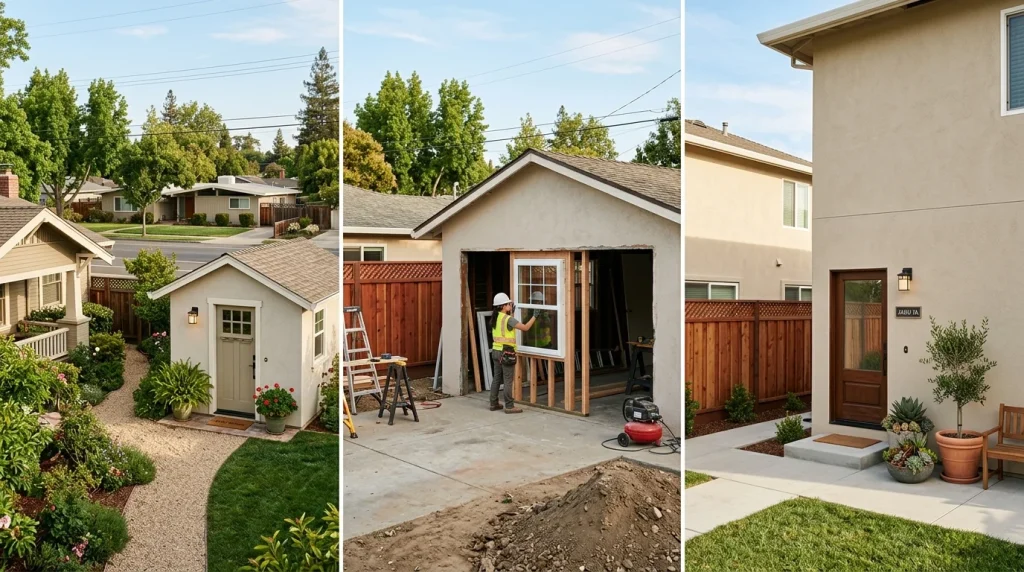
Sunnyvale permits several categories of accessory dwelling units, and knowing which type fits your lot and goals is the first decision every homeowner needs to make.
Detached ADU
A standalone structure separate from the primary home, typically built in the backyard or on an unused corner of the lot.
- Requires its own foundation and utility connections
- Limited to two stories in Sunnyvale
- Processed ministerially for units up to 800 square feet
- Highest upfront cost but also highest privacy and rental appeal
Attached ADU
Built as a physical addition to the existing residence, sharing a wall with the primary home.
- Can simplify utility tie-ins compared to a detached build
- Must still meet setback and design requirements
- Maximum size: up to 850 sq ft, or up to 1,000 sq ft for two-bedroom configurations
Junior ADU (JADU)
Created entirely within the existing footprint of the primary single-family home, such as from a converted bedroom, basement, or attached garage.
- Cannot exceed 500 square feet
- Must include its own exterior entrance and efficiency kitchen
- No new foundation or major structural work typically required
- Most affordable ADU option for most homeowners
Garage Conversion ADU
Transforms an existing attached or detached garage into a habitable living space.
- California state law prohibits requiring replacement parking when a garage is converted
- Removes one of the most common ADU obstacles on smaller lots
- Design must match the primary structure’s exterior appearance
Interior Conversion ADU
Sometimes created from attic or basement space, this type follows similar principles to the JADU but is categorized differently based on its configuration and level of independence from the primary dwelling.
Sunnyvale ADU Size Limits Explained
Size limits in Sunnyvale blend state minimums with local standards. Here is a quick reference:
| ADU Type | Minimum Size | Maximum Size |
| Detached ADU | 150 sq ft | 1,000 sq ft |
| Attached ADU | 150 sq ft | 850 sq ft (1,000 sq ft for 2+ bedrooms) |
| Junior ADU | 150 sq ft | 500 sq ft |
The 750 Square Foot Rule You Cannot Ignore
One of the most financially significant thresholds in Sunnyvale ADU planning is the 750 square foot impact fee cutoff:
- ADUs under 750 sq ft are completely exempt from development impact fees under California state law
- ADUs above 750 sq ft have fees applied proportionally based on the ratio of ADU size to primary dwelling size
- Keeping your design under 750 sq ft is therefore not just a spatial decision but a meaningful cost-saving strategy
Setback Rules and Height Limits for Sunnyvale ADUs
Setback Requirements
Setback requirements define how close an ADU can be placed to property boundaries. California’s state framework has simplified this considerably:
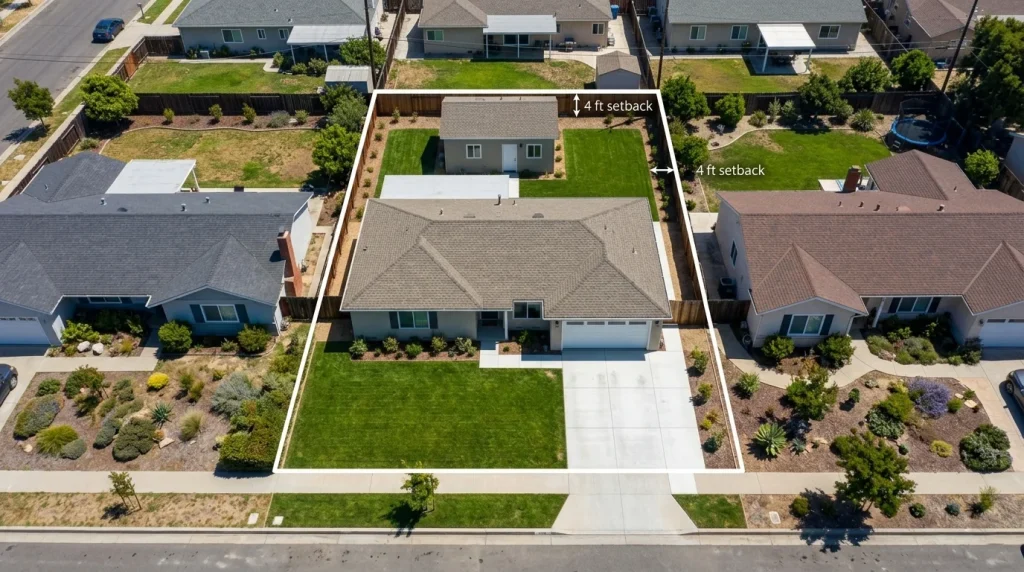
- Detached new-construction ADUs: Minimum setback of 4 feet from both the rear and side lot lines
- Interior conversions of existing space: Not subject to the same setback rules; may be built to the existing structure’s footprint
- Garage conversions already close to property lines: Can generally remain in place without setback adjustments
Height Limits
- Single-story detached ADUs are capped at 16 feet
- Two-story detached ADUs are permitted, though height limits for those configurations should be verified against your parcel’s specific zoning conditions
- Attached ADUs generally follow the height rules that apply to additions on the primary dwelling
Design Compatibility Requirements
One nuance that catches many homeowners off guard is Sunnyvale’s design compatibility rule:
- Exterior materials, colors, and overall appearance of a detached ADU must match the primary structure on the same lot
- Interior conversions are not subject to this requirement
- New construction or additions visible from the street must present a cohesive architectural look
Parking Requirements for ADUs in Sunnyvale
Parking is one area where state law has been especially decisive. The key rules are straightforward:
- No additional off-street parking is required for any ADU in Sunnyvale
- No replacement parking is required when an existing garage is converted to an ADU
- If ADU parking is voluntarily provided, it must meet the City’s standards for development
- ADUs near major transit hubs face no parking mandate under any circumstances
This removes one of the single biggest obstacles that previously made ADU development impractical on smaller lots without extra driveway or yard space.
Owner-Occupancy Rules and What AB 976 Changed
The Old Rule Versus the New Reality
For years, California cities could require homeowners to live on the property as a condition of ADU approval. AB 976, which took effect on January 1, 2025, permanently changed that.
Under the current law:
- Cities are permanently barred from imposing owner-occupancy requirements on standard ADUs
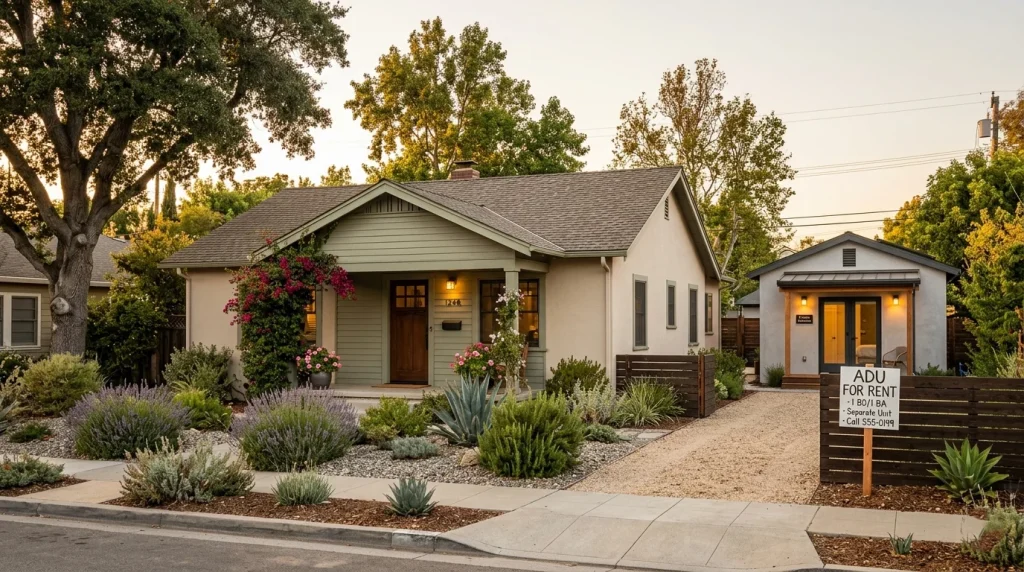
- A Sunnyvale homeowner can build a detached ADU and rent both the main house and the ADU as long-term rentals without living on site
- This applies to all newly permitted ADUs going forward with no sunset date
The One Exception: Junior ADUs
JADUs carry a different rule. When a homeowner builds a Junior ADU:
- Either the primary dwelling or the JADU itself must be owner-occupied
- This condition reflects the JADU’s integrated nature within the existing residence
- It applies regardless of the AB 976 change to standard ADU rules
Short-Term Rentals and Sunnyvale’s Restrictions
California’s ADU-friendly legislation does not extend to short-term rentals. The rules in Sunnyvale are clear:
- Short-term rentals under 30 days are prohibited for ADUs
- Platforms like Airbnb and VRBO are not a permissible income strategy for most ADU owners in the city
- Short-term rental registration is required for any eligible use, and host-occupancy rules apply
- Newer ADUs may not be eligible for non-hosted short-term rental use at all
What This Means for Your Investment Plan
If you are building an ADU with income in mind, the permitted model in Sunnyvale is long-term tenancy. Homeowners who plan any kind of vacation or nightly rental activity should confirm current eligibility and registration requirements with the City’s planning department before finalizing their design or financial projections.
How the Sunnyvale ADU Permit Process Works

Two Permitting Tracks
Sunnyvale’s permitting process operates on two tracks depending on your project type:
Streamlined Track applies to:
- ADUs created within existing or proposed homes
- Interior conversions and garage conversions
- New additions up to 800 square feet
- JADUs and interior ADUs within existing homes (no planning approval required)
Non-Streamlined Track applies to:
- Detached new construction beyond 800 square feet
- Projects with conditions requiring additional review
- Larger or more complex designs that fall outside ministerial standards
Timeline to Expect
- Standard ministerial review: decision required within 60 days of a complete application
- Projects using a locally preapproved plan under AB 1332: 30-day turnaround
- Budget additional time if plan corrections are issued, which is common on first submittals
What You Need to Submit
A complete building permit application requires:
- Construction drawings covering structural systems
- Mechanical, electrical, and plumbing plans
- Site plan showing setbacks, lot coverage, and utility connections
- Compliance with Sunnyvale’s ADU Plan Review Checklist
City Contact Information
- Planning Division: (408) 730-7440 or planning@sunnyvale.ca.gov
- Building Department: (408) 730-7444
- One-Stop Permit Center: Primary intake point for all ADU applications
Impact Fees and the True Cost of Building an ADU in Sunnyvale
What You Will Pay Before Construction Starts
Building costs in the Bay Area are among the highest in the country, and Sunnyvale is no exception. Soft costs can represent 15 to 25 percent of your total project budget and typically include:
- Permit fees (building, planning, and land development)
- Architectural and engineering design fees
- Utility connection charges (water meter, sewer lateral, electrical panel upgrades)
- Soils and geotechnical reports if required
How State Law Limits Impact Fees
California’s ADU legislation places specific caps on what cities can charge:
- Units under 750 sq ft: Exempt from development impact fees entirely
- Units above 750 sq ft: Fees capped at 50% of what would be charged for the primary dwelling, applied proportionally
- Cities cannot require street improvements as a condition of ADU permit approval
The City of Sunnyvale publishes updated fee schedules annually, including FY 2025/26 Building Permit Fees, Land Development Fees, and Planning Division Fees, all available through the Permit Center.
HOA Restrictions and Sunnyvale ADU Rights
Homeowners in communities governed by a Homeowners Association often worry their CC&Rs may block ADU construction. Here is what the law actually says:
- CC&R provisions that effectively prohibit or unreasonably restrict ADU construction on eligible lots are unenforceable under California state law
- HOAs can still apply reasonable, objective aesthetic standards
- HOAs cannot use procedural or blanket prohibitions to block a qualifying ADU
How to Navigate This Early
- Review your CC&Rs before engaging a designer
- Contact your City planner about your specific lot conditions
- Raise any HOA conflicts before you invest in design work, not after
Multigenerational Living and the Non-Financial Case for ADUs
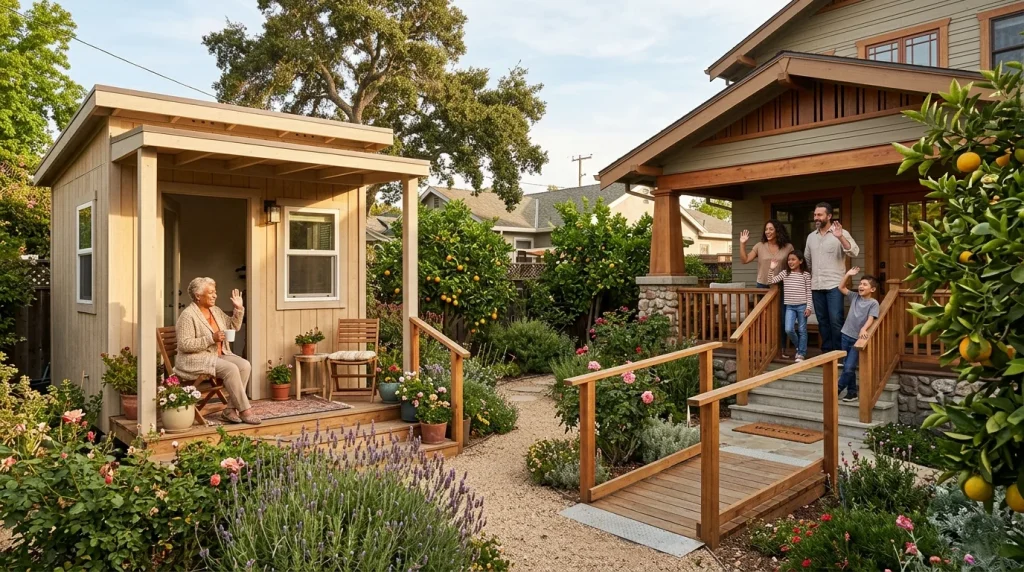
The conversation around ADUs often focuses on rental income and property value, but a significant share of Sunnyvale homeowners build ADUs for entirely different reasons.
Who Builds ADUs for Family Reasons
- Aging parents who need accessible housing close to family without sharing the same living space
- Adult children navigating Silicon Valley’s high cost of living who need a transitional step toward independence
- Families who want to provide live-in care for a relative while maintaining privacy on both sides
- Homeowners who want a dedicated guest suite, home office, or caregiver accommodation
The Flexibility Argument
An ADU built for family use today does not have to stay that way. The unit that houses a parent now can:
- Generate rental income when it is no longer needed for family use
- Serve as a home office or studio space during transitions
- Provide guest accommodation for extended stays
- Be sold separately as a condominium in some configurations
Financial Returns: What Sunnyvale Homeowners Can Realistically Expect
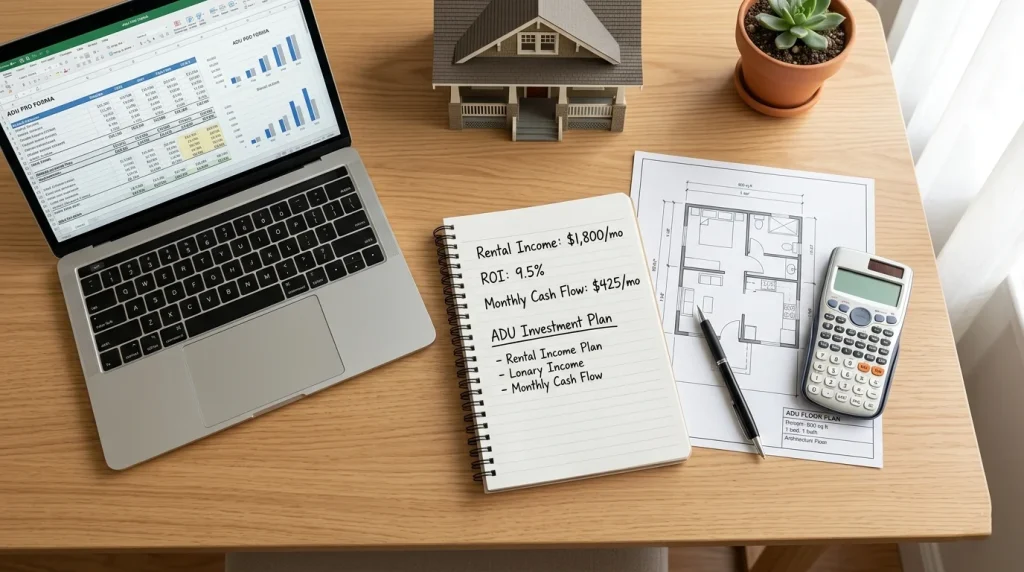
Rental Income Potential
Sunnyvale sits inside one of the nation’s strongest rental markets, fueled by technology employment across Santa Clara County. Key factors shaping your rental return include:
- Unit size and number of bedrooms
- Finish level and quality of construction
- Proximity to transit, employment centers, and amenities
- Whether the unit is detached (more private, typically higher rent) or attached
Research from the Terner Center for Housing Innovation at UC Berkeley notes that ADUs tend to increase buyer interest in properties and can contribute to higher marketability, though the dollar-for-dollar translation of build cost to appraised value varies by unit size, quality, and neighborhood conditions.
Financing Options Available to Homeowners
Common ways to finance an ADU project in Sunnyvale include:
- Home equity line of credit (HELOC)
- Cash-out refinancing on the primary mortgage
- Construction loans from traditional lenders
- ADU-focused lenders that have expanded significantly in the California market
- CalHFA’s ADU Grant Program (check current availability)
Common Mistakes Sunnyvale Homeowners Make When Planning an ADU
Mistake 1: Treating State Law as the Only Layer
State law defines the floor of what cities must allow, but Sunnyvale adds its own enforceable rules on:
- Height and setback specifics
- Design compatibility with the primary structure
- Window placement for privacy relative to neighboring properties
- Utility connection standards
Assuming state law covers everything leads to rejected permit applications and expensive redesigns.
Mistake 2: Underestimating Site-Specific Constraints
Every parcel in Sunnyvale has its own conditions. Before engaging a designer, confirm:
- Utility easements crossing the property
- Drainage and grading requirements
- Soil conditions that may require special foundations
- Existing infrastructure that limits placement options
- Lot shape and coverage limits for your zoning district
A property feasibility review before design work saves far more money than it costs.
Mistake 3: Planning for Short-Term Rental Income
Sunnyvale prohibits non-hosted short-term rentals for ADUs. Building a unit around Airbnb income without confirming local eligibility results in either an underperforming investment or an active regulatory violation. Confirm your rental strategy is legally permitted before committing to a design.
Working With Sunnyvale’s Planning Department
Steps Before You Submit
The City of Sunnyvale has structured its development review process to be accessible to homeowners. Before submitting formal plans:
- Contact the Planning Division for a pre-application consultation
- Verify your zoning district and ADU eligibility for your specific parcel
- Review setback conditions and any parcel-specific constraints
- Download and study the City’s ADU Plan Review Checklist
- Confirm utility connection requirements with the Building Department
What the ADU Plan Review Checklist Covers
The checklist outlines exactly what reviewers look for in a complete application. It addresses:
- Site plan requirements and setback documentation
- Structural and architectural drawing standards
- Utility connection diagrams
- Design compatibility documentation for exterior materials and colors
- Accessibility requirements where applicable
Submitting a complete and accurate application the first time dramatically reduces the chance of correction letters and delays.
What Sunnyvale ADU Law Means for Homeowners in Practical Terms
Sunnyvale’s ADU regulations reflect a deliberate alignment with California’s statewide push to increase the housing supply through infill development on existing residential parcels. For homeowners, the practical takeaways are concrete:
What You Are Entitled to Under Current Law
- Build a detached ADU without living on the property
- Convert a garage to an ADU without providing replacement parking
- Build an ADU even if your HOA CC&Rs say otherwise
- Receive no impact fees on units under 750 square feet
- Get a permit decision within 60 days of a complete application
- Use a preapproved plan for a 30-day review under AB 1332
What the Law Does Not Do
These protections do not eliminate the need for careful planning. Every Sunnyvale parcel has its own conditions, and the intersection of zoning, utility infrastructure, site geometry, and design requirements means no two ADU projects are identical. The homeowners who get the best results start with a thorough feasibility review, work with professionals familiar with Sunnyvale’s specific standards, and budget realistically for both hard and soft costs before committing to a design direction.
Resources and Next Steps for Sunnyvale Homeowners
Official References
- Sunnyvale Municipal Code Chapter 19.79 — Complete ADU regulations, publicly accessible and regularly updated
- California Department of Housing and Community Development — Statewide ADU resource page summarizing recent legislative changes
- City of Sunnyvale Permit Center — FY 2025/26 fee schedules, ADU Plan Review Checklist, and permit applications
Who to Call
- Planning Division: (408) 730-7440 or planning@sunnyvale.ca.gov — Questions on zoning, permits, and fees
- Building Department: (408) 730-7444 — Questions on construction and utility requirements
- One-Stop Permit Center: Primary point of contact for submitting all ADU applications
No article or third-party resource substitutes for a direct confirmation from the City on parcel-specific conditions, zoning eligibility, and current fee schedules. Use these resources as a starting point, then verify everything with Sunnyvale’s planning staff before you commit to a design.
This article is for informational purposes only and does not constitute legal, financial, or construction advice. ADU regulations are subject to legislative updates. Always verify current requirements with the City of Sunnyvale’s Planning Division before making any development decisions.